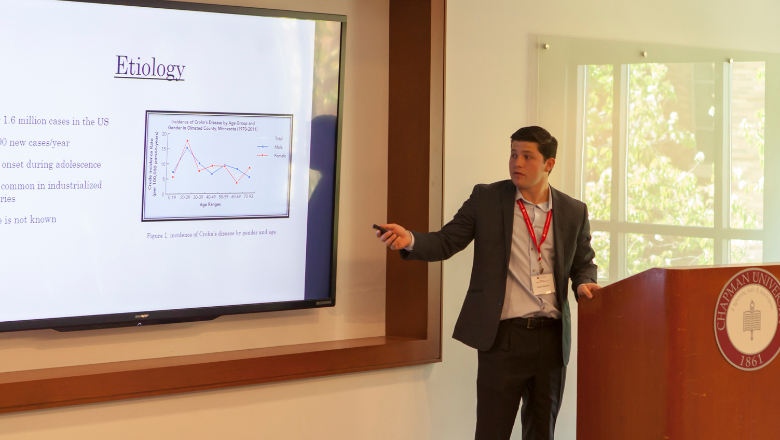
• student-presenter
Center for Undergraduate Excellence

Student Scholar Symposium

»Student Scholar Symposium

Fall Symposium

Abstract Deadline - Sunday, November 1 

Abstract submissions will open October 1st

Apply Here - Posters

Apply Here - Oral

Poster Sessions, Wednesday, December 2
Sandhu Conference Center
Session 1: 9:30 AM - 11:00 AM
Session 2: 1:00 PM - 2:30 PM

Oral Sessions, Thursday, December 3
AF 209ABC
Session 1: 10:00 AM - 11:00 AM
Session 2: 11:30 AM - 12:30 PM
Session 3: 1:00 PM - 2:00 PM

Chapman University understands the importance of undergraduate research and creative activity as fundamental to a student's academic journey. The Center of Undergraduate Excellence continuously strives to support and provide opportunities for undergraduates to thrive and expand their research knowledge and creative accomplishments. The Student Scholar Symposium celebrates the breadth and depth of scholarly research and creative exploration by Chapman University undergraduate students.

Experience a showcase of projects from diverse academic and creative disciplines. Interact with student researchers and their innovative presentations, reflecting rigorous inquiry across the campus.

Presentations are open to ALL disciplines.

Guidelines and Requirements


Toggle Section

Participation and Important Dates

  • Abstract submission deadline – TBA
  • Poster printing deadline – TBA
Visit the Presenter Information Portal for the link to upload your poster

Abstract Guidelines and Requirements

  • Clearly state the project's central research question and/or purpose. Provide brief, relevant scholarly or research context that demonstrates how the project contributes to the area of inquiry. Provide a brief description of the research or creative methodology. State expected results and/or conclusions. Include text only (no images or graphics). Be well-written and well-organized.

  • Abstracts should run 200-300 words with no paragraph breaks. Maximum length: 2100 characters (approximately 300 words).

  • Use plain text format for your abstract. The form will not process some formatting and special characters (e.g., scientific symbols). References are allowed but not required.
     
  • When submitting your abstract, have the following information:
      • Name of Primary Author and Co-Author(s)
      • Chapman e-mail address for each student and faculty mentor
      • Field of study for each faculty mentor and student co-author
      • Title and abstract
      • AI Statement (see AI Policy dropdown)
  • GROUP PROJECTS - Designate one person from your group to submit the abstract. Only one abstract should be submitted for each project during the same poster session.

Artificial Intelligence (AI) Policy

Artificial intelligence policy for the Center for Undergraduate Excellence

This policy establishes expectations for the ethical, transparent, and responsible use of artificial intelligence (AI) tools in all CUE-affiliated activities. This policy applies to both students and faculty when participating in any CUE-supported programming or applying to any CUE awards or fellowships. This document is intended to supplement existing university guidance on the use of AI in research/scholarship/creative activities and we encourage faculty and students to review the university AI guidelines in detail as well.

Guiding principles

Our AI policies are grounded in the following beliefs:

  • Academic integrity and authenticity:All work presented at CUE events must represent the presenter’s own intellectual thought and work and should not be materially generated by AI. Similarly, any applications submitted to CUE must also represent the applicant’s own thinking and lived experiences.
  • Transparency:As noted below, there are certain use cases where AI use is acceptable. In these scenarios, full transparency is expected. AI use should be disclosed when it materially shapes application or research outputs.
  • Privacy and confidentiality:All students, faculty, and staff engaged in research that is supported by CUE must protect sensitive, personally identifiable, proprietary, or unpublished research information following Chapman’s guidelines on confidentiality and privacy.
  • Accountability:Users are responsible for accuracy, citations, and compliance with all fellowship rules, mentor expectations, and university policies, and are ultimately responsible for anything they submit or share with a broader audience.

Acceptable and prohibited uses

For all CUE-sponsored applications and presentations, applicants are permitted to use AI tools as assistive support. This includes:

  • Brainstorming topics, questions, or perspectives
  • Outlining essays, proposals, and personal statements based on student/faculty-generated ideas
  • Editing for clarity, grammar, tone, and conciseness
  • Creating visual supplements for scholarly presentations and submissions
  • Summarizing publicly available sources

Faculty and students are not allowed to use AI for the following:

  • Generating or rewriting substantive text beyond minor copyediting
  • Submitting or presenting any AI-generated text, images, or code as one’s own without disclosure when it materially contributes to the final work
  • Fabricating experiences, awards, research results, citations, quotes, or references
  • Using AI to impersonate another person

In short, AI can be used to support the brainstorming and revision process, but any work presented or submitted should represent the individual’s own intellectual thought.

Disclosure

Individuals must disclose AI use when it:

  • Produces code used in analysis or results
  • Creates figures/visuals included in final submissions
  • Shapes research design, interpretation, or framing in meaningful ways


AI Statement

As part of all CUE applications that require student-produced documents, applicants will be asked how AI was used in developing the document(s). Applicants should be prepared to answer this question as part of the application. If AI was not used, indicate this in the response.

AI statement examples:

  • “I used AI to suggest edits for clarity and concision on text I drafted. I reviewed and revised all outputs and take full responsibility for the final content.”
  • “I used AI to brainstorm potential research questions and produce an initial outline. The final framing and all writing are my own.”
  • “I used AI to generate initial code suggestions for [task]. I tested, modified, and verified the code and results.”

Failure to disclose AI use will be treated as a violation of Chapman’s academic integrity standards.

Fellowship application integrity and sponsor rules

CUE works with students across campus to promote applications to many external fellowships. Many of these fellowships have their own AI use policies, which may be stricter than the ones outlined here. Students applying to these fellowships are responsible for reviewing sponsor policies and must comply with the most restrictive requirements, ensuring that they meet all sponsor requirements. CUE will encourage students to check program rules regarding AI or outside assistance and provide guidance on ethical drafting and revision practices, but the ultimate responsibility for compliance with external fellowship policies rests with the student.  If a fellowship sponsor prohibits AI use, students must not use AI in any part of that submission process (including brainstorming, drafting, or editing) unless the sponsor explicitly allows it.


AI disclosure statement: This policy was drafted with the help of generative AI to brainstorm ideas.

Poster Guidelines

Poster design can significantly enhance or severely diminish the effectiveness of your presentation. The guidelines are general considerations.

  • Standard size: 48" x 36" landscape (template)
  • Minimum font size - (32 pt)
  • Preferred Font type - Arial or Helvetica
  • Font Color - Black  
  • Need help designing your academic poster?  View the video link for helpful poster design tips: Academic Poster Design Tutorial

Poster Printing Deadline - TBA, Print Here

Presentation Options


Toggle Section

Poster Presentation

Poster Presentation

Research-based presentation accompanied with an academic poster.

  • Each session is 1.5 hours in length.
  • Presenters must arrive at least 20 minutes early to check-in and set up at assigned presentation location.
  • Poster printing is available through CUE. See Poster Printing Guidelines drop down for specific details and deadlines.

Professional Courtesy

This symposium provides a setting for attendees to observe and learn conference etiquette. Presenters are expected to be available at their poster for the entire session to present and engage with session attendees.

Oral Presentations

Research-based oral presentation generally supplemented with a slideshow or video (i.e., PowerPoint, original film).

Presentation

  • Each session is one hour in length with four (4) presenters.
  • Oral presentations are limited to 15 minutes per presenter. Individual presentation timelines are as follows:
  • 10 minutes for presentation
  • 5 minutes for Q&A
  • Time limits are strictly enforced by the moderator.
  • Presenters are required to arrive at least 10 minutes before the start of the assigned session to set up presentation and any other resources necessary for a successful presentation. 

Professional Courtesy

This symposium provides a setting for attendees to observe and learn conference etiquette. Presenters are expected to remain in the room until the completion of the session to engage with fellow presenters.

Music, dance, theatre, film, and visual art research and/or analysis, i.e., theory, education, or history, fall under oral presentations.

Visual Arts

Music, dance, theatre, film, and visual art research and/or analysis, i.e., theory, education, or history, fall under oral presentations.

Types of Artwork

Submissions of artwork will be considered from students in any major and in the following material forms, including but not limited to:

  • Fine Art
  • 2D – works on paper, works on canvas, collage
  • 3D – sculpture, installation, ceramics
  • Video
  • Graphic Design
  • Logo design
  • Shirt & Apparel Design
  • Books, magazines, catalogs
  • Illustrations

Presentation

Visual Arts presenters must give an oral presentation documenting their work and creative process.

Visual Arts sessions will be one hour in length.

  • Each session is one hour in length.
  • Presentations are limited to 5 minutes per presenter. 
  • Presenters are required to arrive at least 10 minutes prior to the start of the assigned session to set up presentation and any other resources necessary for a successful presentation. 

Visual Art Exhibition

CUE will display the presenter's artwork in the Student Scholar Symposium Visual Art Exhibition in the Student Union in Argyros Forum.

  • Art piece must be turned into CUE by Friday, April 14th for installation.

Performing Arts Presentations

Music, dance, theatre, film, and visual art research and/or analysis, i.e., theory, education, or history, fall under oral presentations.

Types of Performance
  • Music
  • Music: original composition or arrangement 
  • Musical performance 
  • Lecture recital 
  • Dance
  • Dance performance or choreography 
  • Theatre
  • Original work: monologue or scene (up to 5 actors) 
  • Interpretive work: monologue or scene (up to 5 actors) 

Presentation

Performing Arts presenters must give an oral presentation documenting their work and creative process along with a brief performance of their project. 

Music and Theatre

  • Each session is one hour in length with three presenters.
  • Presentations are limited to 20 minutes per presenter. Individual presentation timelines are as follows:
  • 15 minutes for presentation
  • 5 minutes for Q&A
  • Time limits are strictly enforced by the moderator.
  • Presenters are required to arrive at least 10 minutes prior to the start of the assigned session to set up presentation and any other resources necessary for a successful presentation. 

Dance

  • Each session is one hour in length with four presenters.
  • Presentations are limited to 15 minutes per presenter. Individual presentation timelines are as follows:
  • 10 minutes for presentation
  • 5 minutes for Q&A
  • Time limits are strictly enforced by the moderator.
  • Presenters are required to arrive at least 10 minutes prior to the start of the assigned session to set up presentation and any other resources necessary for a successful presentation. 

Professional Courtesy

This symposium provides a setting for attendees to observe and learn conference etiquette. Presenters are required to remain in the room until the completion of the session.

Publication and Past Presentations


Toggle Section

Past Keynote Speakers

2019: Dr. Zeinab Dabbah '12, born in Cairo, Egypt, and received her MD at Cairo University; she graduated cum laude in 2012 with an Emphasis in Advocacy and Dispute Resolution from the Fowler School of Law, and recipient of the Chapman University Distinguished Alumni Award. Watch Zeinab Dabbah's Keynote! 

2018: Frederick J. Simon, 20 years of service with the FBI, Office of Public and Congressional Affairs, Evidence Response Team

2018: Anissa Hassouna, Member of Egyptian Parliament, Frist woman elected to the Board of the Egyptian Council for Foreign Affairs and Author of Without a Prior Notice.Watch Anissa Hassouna's Keynote! 

2017: Carolyn Forche, Award-winning Poet of Witness, Human Rights Advocate, Chapman University Presidential Fellows, Director of Center for Poetics and Social Practice at Georgetown University. Watch Carolyn Forche's Keynote!

2017: Mike Paul Hughes, NASA Engineer, Music Producer, Composer, Writer, Inspirational Speaker. Deputy Project Manager, ASPIRE, NASA Jet Propulsion Lab and Researcher in Advanced Mars Entry, Descent, and Landing Systems. Watch Mike Paul Hughes' Keynote!

2016: Nancy Perloff, Ph. D., Curator of Modern and Contemporary Collections for the Getty Research Institute. As a trained musicologist and art historian, scholarly research and creative activity have played an integral role in Perloff’s life and career. Watch Nancy Perloff's Keynote!

2016: Robert Akscyn, Founder and President of Knowledge Systems, Hypertext pioneer, First Chair of SIGLINK, ACM’s special Interest Group on Hypertext and the Web, honored by field colleagues via “Akscyn’s Law,” former Chairman of the Board for four high-technologies companies. Watch Robert Akscyn's Keynote!

2015: Kenneth E. Phillips, Ph.D., Curator for Aerospace Science at the California Science Center, Caretake of Space Shuttle Endeavor. Watch Kenneth E. Phillips' Keynote!

2015:  M.G. Lord, Cultural critic, investigative journalist, and comedian. Author of The Accidental Feminist, Astro Turf, and Forever Barbie. Former Newsday editorial cartoonist.

2014: Akin C. Ceylan, COO Home Entertainment, Lionsgate. Chapman University Alumnus, Class of 1990, Chapman Alumni Association Board, VP Communications.

2014: Jennifer Backhaus, Founder and Artistic Director of Backhausdance, OC award-winning contemporary dance company. One of OC Metro's "40 Under 40" in 2009. Alumna of the year, Chapman University. Teaching Artist for the Segerstrom Center for the Arts' community education program.

2013: Robert Diaz, Corporate Transactional Attorney, Finlayson Williams Toffer Roosevelt & Lilly LLP., Chapman University Alumnus, Class of 1997.

2012: Dr. Arthur Benjamin, Professor of Mathematics, Harvey Mudd College and Magician.

Abstract Volumes


Digital Commons

Chapman University Digital Commons is an open-access digital repository designed to collect, store, index, and provide access to the scholarly and creative output of Chapman University faculty, students, staff, and affiliates. In it are faculty research papers and books, data sets, outstanding student work, audiovisual materials, images, special collections, and more, all created by members of or owned by Chapman University.

If you present at the Student Scholar Symposium, your poster will be uploaded to the Digital Commons. You can access the Digital Commons here.