…Then write your own
As an Environmental Science and Policy student at Chapman, you’ll have plenty of opportunities
of your own to explore your interests, pursue your goals and find your path as an environmental professional. Here’s what you’ll learn, plus a look at where it might take you.
Take classes
You’ll take classes with a focus on biology, geology, ecology, and environmental policy. Why the last one? Because environmental science needs the backing of legislation to drive lasting, positive environmental policy. (If it sounds overwhelming, don’t
worry; we’ll help you get there.)
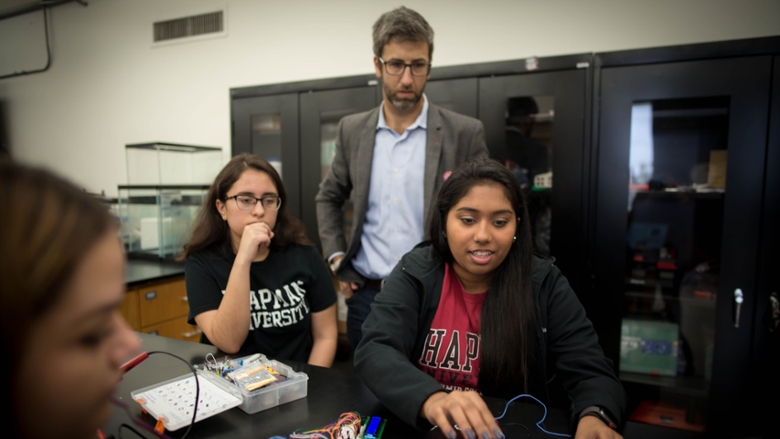
Along the way, you’ll take ENV 205, a professional-development seminar series where you will join the conversation on current, real-world science and policy issues
as well as complete a resume and cover letter, learn how to find jobs and more.
For a more detailed look at the classes you will take, check out our Environmental Science and Policy catalog page.
Dive into research
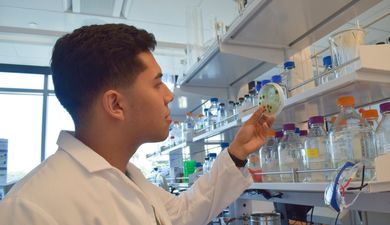
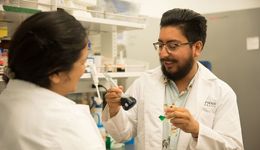
Research in the lab and the field is at the heart of any environmental scientist’s
work. At Chapman, you’ll have plenty of opportunities to get involved, starting as early as your first semester.
You’ll have the chance to do hands-on research in:
- Climate change ecophysiology
- Environmental health
- Water resource management
- Remote sensing using NASA satellites
- Science communication
- Bioaccessibility and bioavailability of toxic metals and metalloids in contaminated
soils and sediments
At the end of the program, you’ll complete a capstone research project as a culmination
of your research and present it at our Student Scholar Symposium.
Get connected
Being a science student isn’t just about the classwork and the research projects.
It’s also about following your passion as a part of the larger scientific community.
Find your focus
In the program, you’ll get to choose your specialization (biophysical science or social sciences), putting you on track to follow your interests
and achieve your goals.
Synthesize your studies
Finally, in your last year in the program, you’ll help put together our annual environmental
audit. This audit focuses on a single local company or organization each year and
collates local environmental data to provide actionable solutions to sustainability
issues.
Past audits have focused on:
- Waste management, reusables, and sustainable food options.
- Energy efficiency, behavior change, LEED EBOM certification, and sustainability policies.
- Overall water and landscaping processes and alternatives.
Past organizations that our students have audited include:
- The Honda Center, a local sports arena
- The City of Costa Mesa
- Chapman University (a self audit)