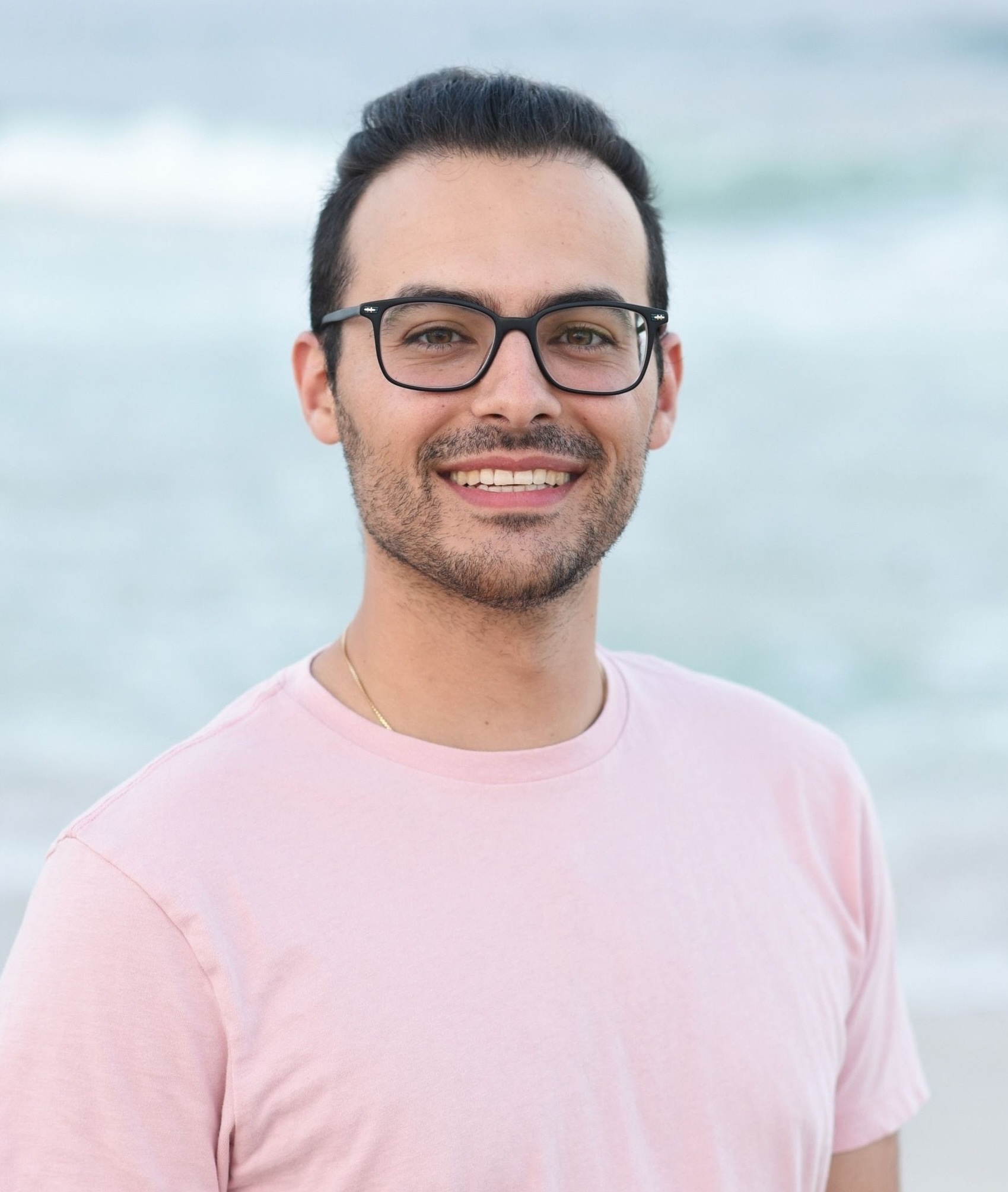
Dr. Vincent Esposito
Assistant Professor
Chemistry, Schmid College of Science and Technology
Email: vesposito@chapman.edu
- Education:
- University of South Carolina - Columbia, Bachelor of Science
University of Pennsylvania, Master of Science
University of Pennsylvania, Ph.D.
Biography
The Esposito lab at Chapman University specializes in the computational chemistry
exploration of Astrochemistry. Research in the Esposito Lab uses computational chemistry
(quantum chemistry) techniques to investigate the chemical properties of molecules
in space. This work spans across the electromagnetic spectrum in the form of photochemistry
and electronic spectroscopy (UV/vis), vibrational spectroscopy (infrared), and rotational
spectroscopy (microwave/radio). Only 90 years ago, space was thought to be an empty
vacuum. Since then, over 300 molecules have been detected in space with the help of
powerful telescopes, sophisticated laboratory experiments, and advanced computational
techniques (termed the "triangle of astrochemistry"). The Esposito Lab at Chapman
forms one small piece of this triangle, and through many domestic and international
collaborations, we hope to arrive at a deeper understanding of our Universe.
Dr. Esposito obtained his Bachelor's degree in chemistry from the University of South Carolina. There, he worked with Dr. Susan Richardson studying disinfection by-products in drinking water. During his undergraduate studies, Dr. Esposito spent a summer at the NASA Goddard Space Flight Center where he first became interested in astrochemistry.
Following his undergraduate studies, he earned his PhD. in Physical Chemistry from the University of Pennsylvania. He was co-advised by Dr. Marsha Lester and Dr. Joseph Francisco. During his graduate studies, Dr. Esposito used computational methods to study the rotational, vibrational, and electronic spectroscopy of small, metal-bearing molecules of astrochemical interest as well as their photochemical pathways. Additionally, he studied the reaction dynamics and photochemistry of Criegee intermediates via experimental and computational methods.
Before coming to Chapman, Dr. Esposito was a NASA Postdoctoral Fellow at the NASA Ames Research Center in Mountain View, CA where he studied the absorption and emission spectra of polycyclic aromatic hydrocarbons (PAHs). These are big carbon sheets, often with hydrogens around the outside, but sometimes with other substituents like deuterium and cyano.
Dr. Esposito obtained his Bachelor's degree in chemistry from the University of South Carolina. There, he worked with Dr. Susan Richardson studying disinfection by-products in drinking water. During his undergraduate studies, Dr. Esposito spent a summer at the NASA Goddard Space Flight Center where he first became interested in astrochemistry.
Following his undergraduate studies, he earned his PhD. in Physical Chemistry from the University of Pennsylvania. He was co-advised by Dr. Marsha Lester and Dr. Joseph Francisco. During his graduate studies, Dr. Esposito used computational methods to study the rotational, vibrational, and electronic spectroscopy of small, metal-bearing molecules of astrochemical interest as well as their photochemical pathways. Additionally, he studied the reaction dynamics and photochemistry of Criegee intermediates via experimental and computational methods.
Before coming to Chapman, Dr. Esposito was a NASA Postdoctoral Fellow at the NASA Ames Research Center in Mountain View, CA where he studied the absorption and emission spectra of polycyclic aromatic hydrocarbons (PAHs). These are big carbon sheets, often with hydrogens around the outside, but sometimes with other substituents like deuterium and cyano.
-
Recent Creative, Scholarly Work and Publications