- Center For Undergraduate Excellence
- External Fellowships and Scholarships
- Resources for Undergraduates
- 291/491 Student-Faculty Research and Creative Activity Course
- Student Scholar Symposium
- Faculty Research and Creative Scholars Expo
- Undergraduate Lunch with a Professor
- Contact Us
- Summer Undergraduate Research Fellowship (SURF)
- Undergraduate Scholarly/Creative Grants
- Undergraduate Travel Grants
- Student Scholar Ambassadors
- Follow
»
About Research and Creative Activities
What is research? What are creative activities?
Research is more than just "looking stuff up"—it's about asking questions and finding ways to answer them using the tools and methods of a particular field. In chemistry, that might mean designing and running experiments in a lab; in history, it could be digging into archival documents to uncover stories that haven’t been told; in psychology, it might mean running surveys to better understand human behavior; and in music, you might be studying new interpretations of a symphony. In short, you’re generating new knowledge for the world.
Creative activities encompass making something new that expresses ideas, emotions, and perspectives. This might mean developing a new play or performance, producing a series of paintings or digital works, writing a novel or collection of poems, or composing a new piece.
What does it mean to do independent research?
This term is a bit misleading; it does not mean you have to do everything yourself! Instead, students conduct research or creative activities under the mentorship of a faculty member. The "independent" refers to the fact that such research is typically independent of a traditional course you might take, though research can also be done in courses. So don’t worry; it doesn’t mean you have to have a research question or special expertise ready to go. Your faculty mentor can help guide you through this process!
Why should I conduct research or creative activities?
There’s nothing quite like the feeling of discovering something completely new to the world, generating new knowledge on a topic, or sharing your creativity with the community! You could be advancing knowledge on how to cure breast cancer, studying the anthropology of the International Space Station, analyzing political and cultural forces that shaped post-colonial transitions in different countries, writing a historical novel based on the Salem witch trials, or composing a piece that combines classical music with hip hop.
In addition, multiple studies have found that there are many benefits for students conducting research and creative activities, including large increases in scientific and professional skills, the ability to explore new areas and potential career paths, and preparation for future careers. You can also earn course credit for doing research and creative activities and get paid for it as well—read more below! Finally, doing research and creative activities can also provide pathways to prestigious fellowships and scholarships, graduate and professional programs, and jobs in the future!
Do I need to come up with my own idea to do research or creative activities?
Not necessarily. In STEM fields as well as psychology and social sciences, students can often start research by joining an existing project led by a faculty member. In the humanities and the creative arts, students typically work closely with a faculty mentor to develop projects based on the student’s interests and the faculty member’s expertise. Working with a faculty mentor helps you learn the research process, gain skills, and explore different topics before committing to your own idea. Over time, you might develop questions you’re excited to pursue independently—and your mentor can help you shape those into a project. Starting with someone else’s idea or a topic you learned about in a class is a typical way to begin.
How much time will it take?
It varies, and you should discuss time commitment with your mentor once you have identified one (see section below). Your initial work could be as little as 3 hours per week, though this will depend on discipline, project, and mentor. This includes reading articles, meeting with your mentor, collecting data, or rehearsing a performance. Your mentor will work with you to set expectations that fit both the project’s needs and your academic workload. There are also opportunities to engage in research and creative activities over the summer, which are typically paid and require a greater time commitment. See our section below on summer opportunities at Chapman and beyond.
When is the right time to start research or creative activities?
There is no "right" time to start research or creative activities. Some students are eager to jump into research and creative activities in their first year, while other students might be inspired to conduct research or create an original piece of work after taking a class later in their college careers. Some faculty mentors ask for a 1+-year commitment due to the training and mentorship involved, so we advise that you get involved ideally before your senior year!
Who can do research and creative activities?
Anyone—from all majors and all backgrounds—can engage in research and creative activities. You do not have to do research or creative activities related to your major, though some faculty mentors may only accept students who have taken courses in their area of expertise. In addition, there is no prerequisite GPA requirement—many past students have gotten poor grades in some of their classes and have gone on to become successful researchers, scientists, artists, and more!
- Section 1: About Research and Creative Activities
- Section 2: Get Started
- Section 3: Get Credit
- Section 4: Sustain Your Work
- Section 5: Showcase Your Work
- Section 6: Interterm and Summer Opportunities
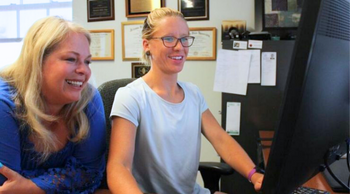
The Faculty Mentor Directory is an online tool that provides undergraduate students a network of faculty members interested in mentoring undergraduate students in research or creative activity. Students can explore the Faculty Mentor Directory to identify potential faculty mentors that inspire or fit their academic and intellectual research/creative interests.