Critical Essay By
Dr. Andrew N. Jordan
Professor, The Kennedy Chair in Physics
Co-Director, Institute for Quantum Studies
Schmid College of Science
View Bio
Erwin Schrödinger (August 12, 1887 – January 4, 1961) was one of the founders of the
field of quantum mechanics, a subdiscipline of physics. He is most noted for the equation
that bears his name, as well as his famous cat paradox, that has penetrated into popular
culture. He had wide-ranging interests and many discoveries in quantum physics, including
the concept and naming of quantum entanglement.
The man
Schrödinger was born and raised in Vienna, Austria-Hungary. His PhD in physics was at the University of Vienna, under Friedrich Hasenöhrl, “On the electric conductivity on the surface of insulators in humid air” in 1910. It was not until the 1920s that he began to work on quantum physics.
He moved around between various academic Institutions in his life, famously leaving Germany’s Friedrich Wilhelm University in Berlin because of his anti-Nazi political beliefs in 1933. In 1940 he settled in the Dublin Institute for Advanced Studies in Ireland, where he lived until 1955 before retiring and returning to Vienna. He died there of tuberculosis at the age of 73.
Despite the fact he was an atheist, he was appointed to the Pontifical Academy of
Science in Rome. His interests were widespread, working on topics such as the theory
of color as well as the quantum explanations of the stability of the genetic structure,
published in his book What Is Life?, in 1944.
The equation
In 1926, Schrödinger wrote a series of important papers on his approach to quantum physics. His first paper, “Quantization as an eigenvalue problem (Part I)”, introduces his namesake equation. It describes the time evolution of a special kind of mathematical function, called a wavefunction. The states that have definite energy (called energy eigenstates) can be calculated for different kinds of potential energy functions, describing systems such as the Hydrogen atom, the harmonic oscillator, a diatomic molecule, and the free rotor. His first paper predicted the allowed energies for the Hydrogen atom, and the second predicted the other mentioned system’s energies. These results agreed with the earlier model of Niels Bohr for the atom, that used ad hoc reasoning to obtain the correct energy levels, based on spectroscopy of Hydrogen gas. However, it also gave a systematic method to be able to compute the quantum energy levels as an eigenvalue problem for motion in any potential, in general.
Before this equation was proposed, Werner Heisenberg had developed a method to make quantum predictions based on the mathematical structure of matrices – arrays of numbers. These two competing methods were ultimately shown to be mathematically equivalent, but Schrödinger’s equation was immediately more popular with physicists, because of the formal similarity to other types of wave equations they had encountered in the physics of waves of water, sound, and light, and the fact it gave a visualization of the physics of a point particle as a distributed wave. Schrödinger won the Nobel prize in Physics in 1933 for his discovery, together with Paul Dirac. The Schrödinger equation and its generalizations remain the cornerstone for predicting the detailed microscopic physics of matter and light to this day.
The cat
However, it was soon recognized that quantum physics is much more than just the Schrödinger equation, a fact that is still not fully appreciated by today’s physicists – it also involves measurement. The wavefunction given by the solutions to Schrödinger’s equation gives many different possible answers to what the values could be taken by the system’s properties, such as energy, spin, angular momentum, position, and so on. However, upon measurement, only one value is seen, and so that the solution of the equation must be interpreted in a probabilistic sense. Schrödinger, together with Einstein, were deeply unhappy with this state of affairs. It led to great frustration for him, leading to the quote at the beginning of the article, as well as his famous cat thought experiment.
The crux of the problem was the Copenhagen interpretation of quantum theory, advanced by Neils Bohr and fellow scientists. According to this view, a macroscopic measurement device was needed to measure the quantum system in order to collapse the wavefunction (accounting for a variety of possibilities existing in superposition) into a single state corresponding to our usual classical reality. This division between the microscopic and macroscopic was viewed as unjustified by Schrödinger. It was also not clear what counts as a measurement device. It is a common misunderstanding that Schrödinger put forth his cat to show the predictions and amazing features of quantum physics – in fact, it was his way of showing the philosophical absurdity of the Copenhagen interpretation of quantum physics.
The cat thought experiment was published in 1935. It envisions a situation where the
quantum superposition of a radioactive atom (which can be in a quantum superposition
between two situations, one of which decays and one of which does not). This leads
to a chain reaction, where the decayed atom causes a Geiger counter to fire, leading
to the smashing of a vile of poison, leading to the killing of a poor cat, who is
stuck inside a box. Since you, as an observer do not observe the state of the cat,
according to quantum theory, it seems as though the cat inherits the state of the
atom – it is also in a quantum superposition of alive and dead! Since we do not observe
such states in our macroscopic classical world, it concludes that the whole program
is nonsense. While this thought experiment is still providing physicists motivation
and cannot be considered fully resolved, Bohr may yet have the last laugh. In the
intervening time, quantum technology has rapidly advanced to the point where we can
now produce quantum states in a superposition of macroscopically distinct states.
What do physicists call such states? Why Schrödinger cat states, of course!
The women (and girls)
A critical essay of Schrödinger would be incomplete without mentioning sex. Despite
the sexual revolution of our western society, that has in one generation sequentially
normalized contraception, divorce, abortion, sodomy, and is currently working on transvestism,
Schrödinger’s sexual proclivities are still frowned upon by polite society, at least
for now. However, the revolutionary’s work is never done, and Schrödinger would be
a good poster child for what will likely come next, without a societal back reaction:
“polyamore” and lowering the age of consent. He was married to Annemarie Berte (Anny)
but was unfaithful in numerous ways (it seems she was, as well). He also lived with
Hilde March, the wife of an Austrian assistant, whom he obtained a visa for when he
moved to Dublin, as a ménage à trois. It seems his previous institution, Oxford University, did not approve of this arrangement.
He had a series of mistresses and had three illegitimate children from them. He also
tutored young girls, and in the case of Ithi Junger began tutoring her at the age
of 14, seduced her at the age of 17, which resulted in pregnancy and her abortion
of the child. His sexual involvement with a series of young girls continued in Ireland.
Walter Moore’s biography of Schrödinger describes him having a 'Lolita complex'. The
closest well-known analogy to this behavior we have in our current time is the late
Jeffrey Epstein. His discovery of wave mechanics (as it is sometimes called) is sometimes
linked to the inspiration of a week’s long Swiss mountain retreat with a copy of de
Broglie's thesis, an unknown girlfriend, with his wife left in Zurich!
To raise, or to raze, that is the question
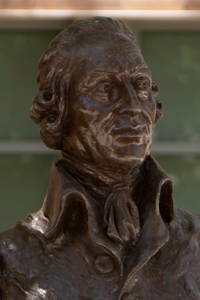
Recalling the point of this essay is to explain why a bust of Schrödinger is sitting
on the Chapman University campus, we must now pause and ask why. Was he a good guy
because he was a great physicist and discovered one of the most important equations
in the history of humanity, or was he a bad guy because he abused young women sexually?
In other words, when putting up statues or pulling them down, which wins? Tearing
down statues has become a very popular thing to do in our society in the past several
years. Confederate general? Melt it down. Owned slaves? Trash it. Involved in the
colonization of other peoples? Destroy it. Even if those people are Robert E. Lee,
Thomas Jefferson, or Cecil Rhodes. Schrödinger is not immune from this attitude either.
In the year 2022 the physics department of Trinity College Dublin recommended the
renaming of a lecture theatre with his name, along with the removal of his picture
and renaming of a lecture series. Every one of us has done great things and things
we should be ashamed of. Those men have done great things, and they have done terrible
things – but they are part of our history, and we erase their memory at our own peril
as a society. Despite the evil he did, we honor Erwin Schrödinger’s memory and scientific
accomplishments which revolutionized our scientific understanding of quantum physics
and changed the world.