»Sala and Aron Samueli Holocaust Art & Writing Contest
Sala and Aron Samueli Holocaust Art & Writing Contest
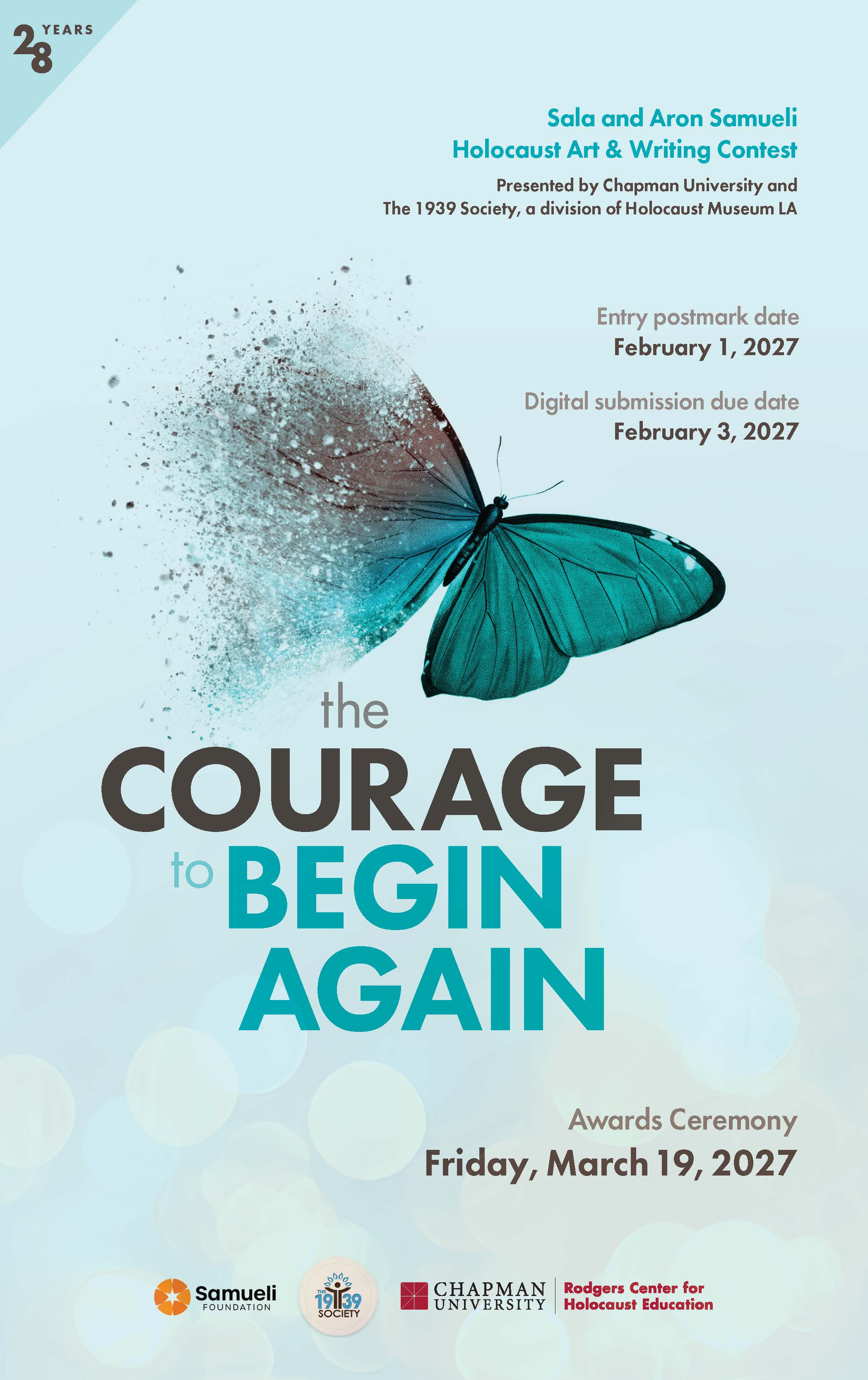
The Courage to Begin Again
 Participating schools may submit a total of three entries (one entry per student) in any combination of the following categories: art,
film, poetry, or prose.
Participating schools may submit a total of three entries (one entry per student) in any combination of the following categories: art,
film, poetry, or prose.
Students will be eligible to win a first prize award of $400 in each category. Educators and schools will also be eligible to win a first prize of $200 each. Students awarded second prize in each category will receive $200, and their sponsoring educator and school will each receive $100.
Inspiration
During the Holocaust, the struggle to survive demanded extraordinary courage. Each day brought unimaginable brutality, suffering, and uncertainty. Simply giving up would have been more than understandable. Yet countless individuals somehow found the inner strength and resilience to rise each morning and face another day. They chose, again and again, to begin anew in the hope of surviving. Tragically, in spite of their courage, many millions, mostly Jews, were murdered.
Often, the Nazis and their collaborators deceived their victims about where they were going and what awaited them. As a result, preparation became impossible. No matter the circumstances, whether one was in a ghetto or camp; in hiding or fighting with the partisans; or separated from one’s parents by a rescue operation, each new day demanded the courage to continue living. In the killing center of Sobibor, 16-year-old Thomas “Toivi” Blatt courageously fought to live each day after witnessing the murder of his parents and younger brother. Every day meant beginning again.
For ten-year-old Vera Gissing, beginning again meant building a life far from home. Sent with her sister Eva from her home in Prague (Czechoslovakia) to safety in England on the Kindertransport in June 1939, Vera endured sadness and loneliness, especially after she was separated from her sister. Each day, she wrote in the diary her father had given her, hoping that one day she could share it with him. Each night, she honored her mother’s request to look at the sky and think of the stars as messengers of her parents’ love. Her diary, memories, and hope became sources of strength as she found the courage to begin life again in a new country.
Liberation and the Allied victory did not end the need to begin again. For survivors, freedom marked the beginning of an entirely new set of uncertainties. Where could they go? Would they be reunited with their loved ones or mourn their loss? Could they make up for lost years of education and gain the skills to find work? While life after liberation held great promise, it was also fraught with the ongoing trauma of loss and required immense courage to face an unknown future.
Most survivors refused to put their lives on hold while they waited to learn which country might accept them. Instead, they chose to embrace life despite profound loss. And over the next decades, many married, started families, established careers, and found the courage to bear witness, sharing their stories so those who had been murdered would be honored and remembered and future generations would learn from their experiences.
In the decades that followed, survivors watched with heartbreak as new genocides unfolded and as others were compelled to find the courage to try to survive and begin again. In 2014, a 19-year-old Iraqi-born Yazidi woman named Nadia Murad was abducted from her family, most of whom were murdered, and taken into sexual slavery by Islamic State fighters. Each day required her to demonstrate the courage to begin again. Eventually, Nadia escaped. Rather than hiding in silence, she found the courage to speak out about her experiences. In 2018, she was awarded the Nobel Peace Prize for defying “the codes of shame… and daring to speak up on the abuses perpetrated against herself and thousands of Yazidi women and children…. she has broken a stigma that has afflicted millions of women victims of wartime sexual violence.”
For those targeted during the Holocaust and for people like Nadia Murad who have endured subsequent genocides, the courage to begin again did not end with survival or liberation. Beginning again is not a single moment but a lifelong act of resilience. It requires both the courage to bear witness to what they experienced and to make the decision, day after day, to begin again.
Prompt
- Select and view one full-length survivor testimony from any of the following:
- Samueli Holocaust Art & Writing Contest website, featuring video testimonies from the collection of the USC Shoah Foundation — The Institute for Visual History and Education at Chapman.edu/contest-testimonies
- South Carolina Council on the Holocaust website at scholocaustcouncil.org/survivor.php
- The 1939 Society website at the1939society.org
- USC Shoah Foundation - The Institute for Visual History and Education’s YouTube channel at Youtube.com/uscshoahfoundation (“Full-Length Testimonies” playlists only)
- USC Shoah Foundation's iWitness site at iwitness.usc.edu
* Lists of testimonies that are one to two hours in length are available on the last page of the Resource Guide.
- As you listen to the survivor’s testimony, identify a specific experience in which
the survivor had to begin again.
- Note a word, phrase, or sentence focusing on the courage it takes to begin again.
This may reflect an act of survival, a decision to persevere, a source of hope, or
a choice to rebuild in the face of loss and uncertainty.
Please note the timestamp from the video testimony where the specific word, phrase, or sentence occurs. - As the person now entrusted with the individual’s story, through your creativity
in art, poetry, prose, or film, explore this word, phrase or sentence as central to
the survivor’s experience. Highlight how they found the courage to endure and to begin
again, whether during the Holocaust or following liberation.
- In your response, include a personal reflection about how the survivor's story of
courage and resilience inspires you. How does their example deepen your understanding
of what it means to begin again, and how might it influence the way you face your
own challenges and opportunities?
We encourage all participants to refer to the Resource Guide for rubrics, specific criteria, and other information.
General Criteria
Please review category-specific criteria in the following sections and in the Resource Guide.
- Regardless of delivery method (digital or hard copy), all entrants must complete the online submission form
- Entries must reflect genuine engagement with the survivor's testimony in its historical context and constitute a thoughtful and creative response.
- Entries must be based on a survivor's testimony available from one of the following
sources:
- Chapman University’s Holocaust Art & Writing Contest website, featuring video testimonies from the collection of the USC Shoah Foundation — The Institute for Visual History and Education at Chapman.edu/contest-testimonies
- South Carolina Council on the Holocaust website at scholocaustcouncil.org/survivor.php
- The 1939 Society website at the1939society.org
- USC Shoah Foundation - The Institute for Visual History and Education’s YouTube channel at Youtube.com/uscshoahfoundation (“Full-Length Testimonies” playlists only)
- USC Foundation's iWitness site at iwitness.usc.edu
- Entries must include a time stamp (timecode) from the video testimony. This is the moment in the testimony that the student chooses that references the theme of the contest prompt.
- Please note that AI-generated works are not permitted. All text and images, whether created by and or digitally, just be the original creation of the student participant.
- Entries that do not follow the criteria will be disqualified.
Art Criteria
- Regardless of delivery method (digital or hard copy), all entrants must complete the online submission form
- Entries must be submitted with the artist’s statement that includes
- Title of the work
- Name of survivor or rescuer to whose testimony this work is a response
- Statement of how the work addresses the prompt
- Statement must not include student or school name and must not exceed 125 words.
- Acknowledgement of sources – to protect copyright holders, proper citation of all sources is required. Permission for sources that are not public domain must be obtained in writing from copyright holder and submitted with entry.
- Please do not staple, tape, or otherwise attach the artist statement to the artwork
- Submissions must be two-dimensional only, on medium no thicker than ¾”, and must not exceed 12” x 18.”
- Artwork must not be matted or framed.
- Fixative spray must be applied to charcoal, pencil, pastel, and chalk art.
- Submissions can include photography and computer-generated images. Artists can use charcoal, pencil, pastel, chalk, watercolors, acrylics, or oils.
- Renderings of another’s work will be disqualified.
- Please note that AI-generated works are not permitted. All images, whether created by hand or digitally, must be the original creation of the student artist.
- Entries that do not follow the criteria will be disqualified.
Film Criteria
- Regardless of delivery method (digital or hard copy), all entrants must complete the online submission form
- Entries must be submitted with the filmmaker’s statement including:
- Title of the work
- Name of survivor or rescuer to whose testimony this work is a response
- Statement of how the work addresses the prompt
- Statement must not include student or school name and must not exceed 125 words.
- Acknowledgement of sources – to protect copyright holders, proper citation of all sources is required. Permission for sources that are not public domain must be obtained in writing from copyright holder and submitted with entry.
- Content viewing time (without credits) may be no longer than three (3) minutes.
- File size must not exceed 600 MB.
- Films are to be submitted without credits for blind judging. A completed film with credits should be prepared in the event the film is selected for screening.
- Films may be submitted using WeTransfer.com, Google Drive, or other free file transfer websites.
- To ensure compatibility with MAC and PC, please use either QuickTime or MPEG format.
- Please note that AI-generatd works or the inclusion of AI-generated works are not permitted.
- Entries that do not follow the criteria will be disqualified.
Poetry Criteria
- Regardless of delivery method (digital or hard copy), all entrants must complete the online submission form
- Entries must be titled.
- Entries must be typed.
- Entries must not include graphics, drawings, or other images. It must be clear that the entry is a poem and not artwork.
- Entries must be created by students. AI-generated works are not permitted.
- Entries must not include reference to student or school name.
- Students should include the name of the survivor or rescuer about whom the entry is written. If the name doesn’t appear in the work, it should appear under the title.
- Entries may be no more than 30 lines.
- Entries that do not follow the criteria will be disqualified.
Prose Criteria
- Regardless of delivery method (digital or hard copy), all entrants must complete the online submission form
- Entries must be titled.
- Entries must be typed.
- Entries must be created by students. AI-generated works are not permitted.
- Entries must not include reference to student or school name.
- Students should include the name of the survivor or rescuer about whom the entry is written. If the name doesn’t appear in the work, it should appear under the title.
- Entries may be no more than 500 words.
- Entries that do not follow the criteria will be disqualified.