»Sala and Aron Samueli Holocaust Art & Writing Contest
Sala and Aron Samueli Holocaust Art & Writing Contest
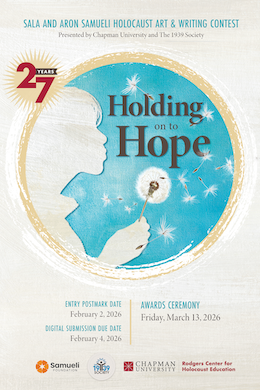
Holding on to Hope
 Participating schools may submit a total of three entries (one entry per student) in any combination of the following categories: art,
film, poetry, or prose.
Participating schools may submit a total of three entries (one entry per student) in any combination of the following categories: art,
film, poetry, or prose.
Students will be eligible to win a first prize award of $400 in each category. Educators and schools will also be eligible to win a first prize of $200 each. Students awarded second prize in each category will receive $200 and their sponsoring educator and school will receive $100 each.
Inspiration
Fragile as the seeds of a dandelion, hope became a source of strength for those persecuted during the Holocaust. Hope took many forms, grounded in memories from the past and dreams for the future. In her memoir, All But My Life, survivor Gerda Weissmann Klein recalls an act of hope when she and her friend looked toward the future and bet on when the war would end and freedom would come.
Memories of good times became a source of hope as a person recalled birthdays and religious holidays celebrated with family and friends and dreamed of such occasions in the future.
Hope also inspired courageous action. Young Tom Blatt knew that the odds of successfully escaping from the Sobibor killing center were extremely slim and yet he dared to crawl under a barbed wire fence and run through a field filled with land mines. When he was shot by the farmer who had agreed to hide him, he hoped that playing dead would enable him to live.
The 24-year-old leader of the Warsaw ghetto uprising Mordechai Anieliewicz knew his fighters were vastly outnumbered by German forces. Though they managed to resist the Nazis for 27 days, military victory was never a real possibility. Instead, Mordechai hoped that their defiance would send a powerful message of resistance and hope into the future, inspiring people to remember and bear witness.
In hiding, young Peter Feigl kept a diary in the hope that one day he could share it with his parents so they could learn of his life when separated from them. Desperately clinging to the railings in an elevator shaft. Eva Brettler’s mother hoped that she could hold on long enough to return to her small daughter hidden in a basket on the top of a wardrobe.
To retain hope under the most inhumane conditions took courage and a belief that one’s actions had purpose. Holding on to hope was never easy, but it was crucial both to survival and to retaining one’s humanity.
Prompt
- Chapman University’s Holocaust Art & Writing Contest website, featuring video testimonies from the collection of the USC Shoah Foundation — The Institute for Visual History and Education at Chapman.edu/contest-testimonies
- South Carolina Council on the Holocaust website at scholocaustcouncil.org/survivor.php
- The 1939 Society website at the1939society.org
- USC Shoah Foundation - The Institute for Visual History and Education’s YouTube channel at Youtube.com/uscshoahfoundation (“Full-Length Testimonies” playlists only)
- USC Shoah Foundation's iWitness site at iwitness.usc.edu
* Lists of testimonies that are one to two hours in length are available on the last
page of the Educator Guide.
2. As you listen to the survivor’s or rescuer's testimony, note a word, phrase, or sentence that references a specific experience that offered hope and gave strength. Reflect on how this experience motivated that person to find meaning and purpose in the midst of their struggle to survive or their efforts to help others to survive.
Please note the timestamp from the video testimony where the specific word, phrase, or sentence occurs.
3. As the person now entrusted with this individual’s story, through your creativity in art, poetry, prose, or film, explore this word, phrase, or sentence as central to the survivor’s or rescuer's experience, and highlight how holding on to hope enabled that person to endure their circumstances and persist against adversity.
4. In your response, include a personal reflection about how the survivor's or rescuer's story of holding on to hope will empower and motivate you as you face your own challenges.
We encourage all participants to refer to the Educator Guide for rubrics, specific criteria and other information.
General Criteria
Please review category-specific criteria in the following sections and in the Educator Guide.
- Regardless of delivery method (digital or hard copy), all entrants must complete the online submission form
- Entries must reflect genuine engagement with the survivor's or rescuer's testimony in its historical context and constitute a thoughtful and creative response.
- Entries must be based on a survivor's or rescuer's testimony available from one of
the following sources:
- Chapman University’s Holocaust Art & Writing Contest website, featuring video testimonies from the collection of the USC Shoah Foundation — The Institute for Visual History and Education at Chapman.edu/contest-testimonies
- South Carolina Council on the Holocaust website at scholocaustcouncil.org/survivor.php
- The 1939 Society website at the1939society.org
- USC Shoah Foundation - The Institute for Visual History and Education’s YouTube channel at Youtube.com/uscshoahfoundation (“Full-Length Testimonies” playlists only)
- USC Foundation's iWitness site at iwitness.usc.edu
- Entries must include a time stamp (timecode) from the video testimony. This is the moment in the testimony that the student chooses that references the theme of the contest prompt.
- Please note that AI-generated works are not permitted. All text and images, whether created by and or digitally, just be the original creation of the student participant.
- Entries that do not follow the criteria will be disqualified.
Art Criteria
- Regardless of delivery method (digital or hard copy), all entrants must complete the online submission form
- Entries must be submitted with the artist’s statement that includes
- Title of the work
- Name of survivor or rescuer to whose testimony this work is a response
- Statement of how the work addresses the prompt
- Statement must not include student or school name and must not exceed 125 words.
- Acknowledgement of sources – to protect copyright holders, proper citation of all sources is required. Permission for sources that are not public domain must be obtained in writing from copyright holder and submitted with entry.
- Please do not staple, tape, or otherwise attach the artist statement to the artwork
- Submissions must be two-dimensional only, on medium no thicker than ¾”, and must not exceed 12” x 18.”
- Artwork must not be matted or framed.
- Fixative spray must be applied to charcoal, pencil, pastel, and chalk art.
- Submissions can include photography and computer-generated images. Artists can use charcoal, pencil, pastel, chalk, watercolors, acrylics, or oils.
- Renderings of another’s work will be disqualified.
- Please note that AI-generated works are not permitted. All images, whether created by hand or digitally, must be the original creation of the student artist.
- Entries that do not follow the criteria will be disqualified.
Film Criteria
- Regardless of delivery method (digital or hard copy), all entrants must complete the online submission form
- Entries must be submitted with the filmmaker’s statement including:
- Title of the work
- Name of survivor or rescuer to whose testimony this work is a response
- Statement of how the work addresses the prompt
- Statement must not include student or school name and must not exceed 125 words.
- Acknowledgement of sources – to protect copyright holders, proper citation of all sources is required. Permission for sources that are not public domain must be obtained in writing from copyright holder and submitted with entry.
- Content viewing time (without credits) may be no longer than three (3) minutes.
- File size must not exceed 600 MB.
- Films are to be submitted without credits for blind judging. A completed film with credits should be prepared in the event the film is selected for screening.
- Films may be submitted using WeTransfer.com, Google Drive, or other free file transfer websites.
- To ensure compatibility with MAC and PC, please use either QuickTime or MPEG format.
- Please note that AI-generatd works or the inclusion of AI-generated works are not permitted.
- Entries that do not follow the criteria will be disqualified.
Poetry Criteria
- Regardless of delivery method (digital or hard copy), all entrants must complete the online submission form
- Entries must be titled.
- Entries must be typed.
- Entries must not include graphics, drawings, or other images. It must be clear that the entry is a poem and not artwork.
- Entries must be created by students. AI-generated works are not permitted.
- Entries must not include reference to student or school name.
- Students should include the name of the survivor or rescuer about whom the entry is written. If the name doesn’t appear in the work, it should appear under the title.
- Entries may be no more than 30 lines.
- Entries that do not follow the criteria will be disqualified.
Prose Criteria
- Regardless of delivery method (digital or hard copy), all entrants must complete the online submission form
- Entries must be titled.
- Entries must be typed.
- Entries must be created by students. AI-generated works are not permitted.
- Entries must not include reference to student or school name.
- Students should include the name of the survivor or rescuer about whom the entry is written. If the name doesn’t appear in the work, it should appear under the title.
- Entries may be no more than 500 words.
- Entries that do not follow the criteria will be disqualified.