»How Do You Design a Course

Syllabus Design

A syllabus has multiple purposes but can help establish clarity for students before the semester begins. General syllabi outline the course schedule, learning outcomes, and a conceptual map highlighting what the course will cover. The syllabus is an important document to maintain as it will be helpful to include in one’s teaching portfolio and evidence of teaching. Here are some resources before starting your syllabus.

Backward Design

Check with your department or school and GSI director first to see if your course can be re-designed and double check as your course learning outcomes and learning objectives may have to stay the same.

Backwards course design is an approach where an instructor designs the course with the end in mind, or the learning outcomes an instructor would like their students to achieve. This method allows for alignment between goals, assignments, and assessments to create an impactful learning experience with a student-centered focus.

For a checklist on course and backward design, click here.


Toggle Section

Step 1: Identify Desired Results (Examples of Sample results)

Before you identify your desired results, you should have course learning outcomes written specifically for your course. What are your broad goals for student learning? Some examples could be related around:

  • Sample Core Concepts & Competencies
  • Knowledge application
  • Critical thinking and problem-solving
  • Communication and collaboration
  • Global and cross-cultural awareness & responsiveness
  • Creativity and innovation
  • Intrapersonal skills (e.g., self-direction, motivation)

Writing Clear, Student-Centered Learning Outcomes

  1. Identifies the Audience; is student-focused
  2. Observable Behavior(action verbs)
  3. Identify any special Conditions of performance (e.g., an oral presentation; given three images of cells...)
  4. Measurable – identifies the Degreeof performance e.g., three examples of...)


Examples: 
 

  • Choreograph a 1-minutecontemporary dance routine to a song on the Billboard Hot 100 list 
  • Identify 3 different principles of representative democracy that were either supported or challenged in the recent handling of student protests on university campuses and provide details to support your answer.

Step 2: Determine Acceptable Evidence (Assessments)

There are two types of evidence assessments:Formative (progress monitoring which consists of practice/lab exercises, knowledge checks such as quizzes and exit tickets, and discussions such as group and practice works) and Summative (evaluative which consists of tests, projects, presentations, papers, performances, simulations, and case studies).

Step 3: Plan Learning Experiences

Make sure your learning experiences (readings, instruction, multimedia, homework, and other assignments) align with the CLOs and prepare students for the assessments and mastery of CLOs.


Toggle Section

Benefits of a Grading Rubric

Rubrics allow students to visualize what is expected of them and the goals that they are working towards for a particular project or assignment and can help clarify instructor expectations.Through ongoing feedback and metacognitive reflection, learners can recognize their individual strengths and areas for growth, ultimately guiding future improvements in their performance. For faculty, rubrics can reduce grading time and multiple explanations of expectations while ensuring consistency across time and graders with appropriate calibration. Similarly, rubrics can help reveals strengths and weaknesses across the class and support intentional modifications to instruction and reduce grading disputes.

Rubric Language: Deficit vs. Asset-Based Language

When designing your own rubric, it is important to keep in mind using asset-based language over deficit-based language to create a more empowering experience for learners. An example of  asset-based language is an “Essay’s theme/thesis can be articulated more explicitly.” instead of saying the “Response shows a complete lack of understanding.” Using asset-based language helps promote growth and empowers students to revise their work by emphasizing their potential rather than what is missing from their assignments. Here are a few more examples of asset-based language:
 
  • “Essay’s theme/thesis can be articulated more explicitly.”
  • “Word choice and sentence structure can be revised to evoke a more powerful sense of the writer’s personality.” 
  • “Arguments would be stronger if they included citations and/or significant quotes from research.”

Toggle Section

What is Transparent Course Design?

Transparent course design is a teaching approach that makes expectations, structure, and intentions clear to students, such as providing detailed information about policies and why they exist. Similarly, transparent course design includes providing detailed guidelines or activities and assessments, and why they are relevant or important to ensure students that they are not wasting their time including: why they are designed a certain way, how they help students achieve learning outcomes, what the instructor wants students to achieve, tell students how long tasks may take, especially out of class assignments, provide communication expectations – how should students communicate with you and when can they expect a response? It also includes built-in flexibility rather than having to address issues on a case-by-case basis (e.g., late policy) and setting professional boundaries and guidelines for appropriate behavior in the classroom. This intentional structure fosters trust, clarity, and student empowerment.

Classroom Assessment Techniques (CATs)

Classroom Assessment Techniques (CATs) are methods instructors use to gather quick, low-stakes feedback on student learning during class. These techniques provide valuable insights into student understanding, allowing instructors to adjust their teaching strategies in real-time and enhance student learning.

For more information, click here.

Bloom's Taxonomy Resources

Bloom’s Taxonomy is a hierarchical framework that can help instructors classify the types of learning experiences they would like to create in the classroom. The taxonomy is organized by complexity and specificity where higher-order thinking is placed at the top of the taxonomy. Depending on the course learning outcomes (CLOs) for the class, instructors can align their outcomes appropriately. For example, a 400-level course will use words higher in the taxonomy such as create, evaluate, and analyze while 100-level courses might use words towards the bottom of the taxonomy, such as apply and understand.
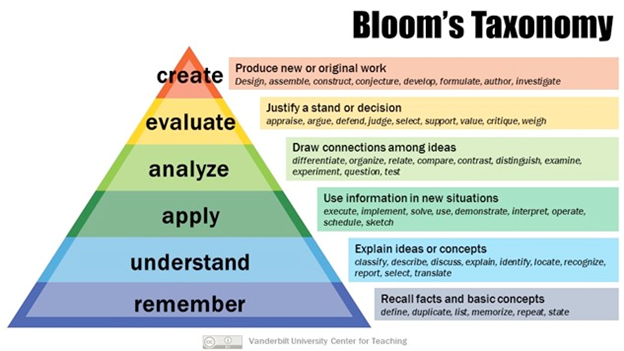
bloom-taxonomy

Inclusive Teaching

“Inclusion is a culture in which all learners feel welcome, valued, and safe” (Hogan & Sathy, 2022, p. 10). Providing high structure in a course with frequent low-stakes assessments provides transparent opportunities for students to learn and engage with course content before, during, and after class with guided instructions or activities. High structure benefits all students by allowing multiple opportunities for feedback throughout the course.


Toggle Section

Teach Students About Learning

Helping students understand your course design can reduce confusion from the beginning of the semester. Whatever we want students to accomplish at the end of the course must be practiced deliberately throughout the term. One way to engage in this practice is to lay assignments out clearly, provide rationale, link objectives, and provide frequent reminders.Students don’t remember information just because the instructor said it; they need to have opportunities to learn and practice independently (Hogan & Sathy, 2022).

According to Lovett et al. (2023), the author of How Learning Works: 8 Research-Based Principles for Smart-Teaching students have not yet mastered meaningful ways of organizing information that they encounter in their courses. One key principle the authors share is “how students organize knowledge influences how they learn and apply what they know” (p. 67). As experts in the field, it can be difficult to identify how to organize the knowledge for our students. These strategies below can help students reveal and enhance their knowledge organizations.

Create a concept map to help students and experts recognize how they organize their knowledge. This can help you represent your knowledge organization visually and you can walk students through your concept map as a way of orienting them to the organizational structure in your domain to help guide them in organizing their knowledge.

Another strategy is to analyze tasks to identify the most appropriate knowledge organization. An example of this is to assign a paper that asks students to analyze theoretical perspectives from different authors vs. A paper that requires students to analyze the impact of a historic event on economic, political, and social factors. Instructors can also provide students with a skeletal outline or template for organizing their knowledge using empty tables to compare and contrast theories, ideas, and perspectives.  

In addition, when instructors introduce new concepts it’s always a good idea to explicitly connect it to previous concepts. Do not assume that students will make the connections. For example, (e.g. You may remember encountering a similar situation in the case study we read last week.”) or ask students questions to help them make the connections themselves “What aspects of this case are similar or different from what we discussed yesterday?”

Factors That Motivate Student Learning

One key principle that Lovett et al. (2023) shared is that “students’ motivation generates, directs, and sustains what they do to learn” (p. 86). If students do not find the course material relevant or interesting, they will not find value in mastering it and therefore will not engage in behaviors associated with deep learning. There are a few strategies that can help positive expectations and motivate students in the classroom:  

  1. Identify an Appropriate Level of challenge – Setting challenging but attainable goals is optimal for motivating students. Pre-assessments can help gauge what students already know and what students’ future goals are.  
  2. Provide Early Success Opportunities – Early success in the classroom can build students’ sense of efficacy. Incorporating early and smaller assignments that account for smaller percentages of students’ final grades can help students build their sense of confidence and competence.  
  3. Provide Targeted Feedback – “Feedback to students is most effective when it is  timely and constructive” (Lovett et al. 2023, p. 103). Allowing students to be able to implement the feedback in the next iteration of the assignment can help teach students that it is about the learning process and not the product.  
  4. Describe Effective Study Strategies – Students may not always be able to identify ways in which they should change their study habits, especially after failure. Discussing specific strategies with them can help them adjust their expectations to help them meet their goals. 

10 Tips for Fostering Inclusive Learning Environments

Terms such as inclusivity, diversity, belonging, and equity come up frequently in education research and literature these days, but what do they actually mean in the context of teaching? As we begin to consider how we can be more inclusive in our teaching practices, it is important to have a clear understanding of what “inclusive teaching” means, and to address some common questions and misconceptions about this topic. Although it may feel daunting, there are some simple things we can do as we work towards this goal.

The Association of College and University Educators (ACUE) provides these 10 practices for inclusive teaching:

  1. Ensure your course reflects a diverse society and world.
  2. Ensure course media are accessible.
  3. Ensure your syllabus sets the tone for diversity and inclusion.
  4. Use inclusive language.
  5. Share your gender pronouns.
  6. Learn and use students’ preferred names.
  7. Engage students in a small group introductions activity.
  8. Use an interest survey to connect with students.
  9. Offer inclusive office hours.
  10. Set expectations for valuing diverse viewpoints.

The ACUE handout includes specific strategies for each of these practices, along with links to videos, samples, and further information about each strategy. As you plan for your next course, begin to consider how you might implement one or more of these or other strategies for inclusive teaching in your own practices.

Universal Design for Learning

Universal Design for learning (UDL) has often been viewed as “doing inclusion” or “doing diversity” from a deficit or savior-point of view. UDL reduces barriers to learning and access by allowing students multiple means of representation. In other words, giving students multiple opportunities to learn course content. Similarly, UDL involves multiple means of expression which allows students to be assessed in a variety of ways and UDL also involves multiple means of engagement inside and outside the classroom.


Toggle Section

What is Universal Design for Learning?

Universal Design for Learning (UDL) is a framework for designing materials and instructional methods that are usable by a wide range of students. UDL encourages flexible learning conditions that ensure access for all learners, without lowering expectations or standards. UDL-based learning environments give students a variety of options to demonstrate mastery and numerous opportunities for active engagement in the learning process. It focuses on reducing physical, cognitive, and organizational learning barriers.

The Three Principles of UDL

Principle 1: Multiple Means of Engagement  

Multiple means of engagement refers to different opportunities for student involvement (e.g., interactive activities, group discussions, online discussion boards). This principle reflects the idea that students have different motivations to engage in learning. 

Principle 2: Multiple Means of Representation 

Multiple means of representation is about providing learners various ways to access and engage with course materials and information. In its simplest form, this could mean offering textbooks in audio or multimedia formats.   

Principle 3: Multiple Means of Action & Expression  

Multiple means of action and expression encourages students to demonstrate their learning through various forms (e.g., exams, multimedia, concept maps, papers, projects). This principle highlights executive functioning, where students apply what they learn strategically.