»Matt Parlow’s Presidential Investiture Speech
Watch or read Chapman President Matt Parlow’s speech on the importance of education from his Presidential Investiture Ceremony on Oct. 10, 2025.
Read President Parlow's Speech
Acknowledgements
Thank you, Mr. Chairman, and thank you Park for those kind words of introduction.
My thanks also to Amy Rogan-Mehta, who has done a fantastic job leading the presidential
transition and planning this week’s events with an immensely talented team. And as
we sit here in the beautiful Musco Center for the Arts, I’d like to thank Marybelle
Musco for the vision that she and Paul had for this magnificent building. Marybelle,
we miss Paul every day, but his inspiration is with us today and always.
If it were up to me, I would start and end my remarks with “Thank you. I’m humbled. I’m honored. Now let’s get to work.” But they told me I had to say more than that. So permit me to start with some important acknowledgements before getting to the heart of my remarks.
First, I would like to express my gratitude to our President Emeritus Daniele Struppa.
Daniele, I don’t know where to begin. You have left an indelible mark on this great
university. We are changed – for the better – because of you. You have also been the
most wonderful mentor to me, and I cherish our friendship. I would not be standing
here today without you. On behalf of the entire Chapman Family, thank you for 19 years
of remarkable leadership and for sharing your joy and passion for education with us.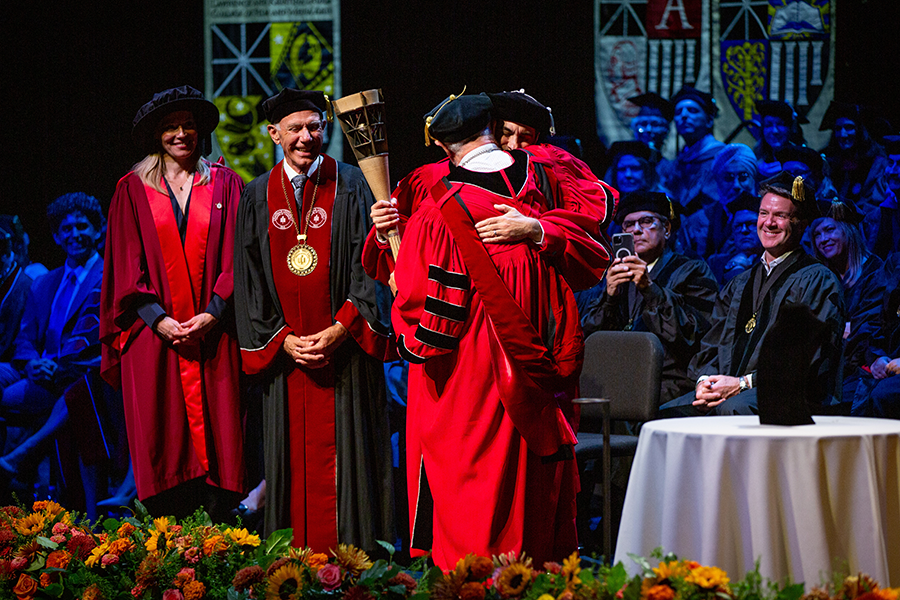
Parlow and Struppa embrace after Struppa passes the university mace to Parlow.
I also want to thank President Emeritus Jim Doti. Jim, your extraordinary leadership for twenty-five years made Chapman what it is today. Your DNA is inextricably woven into all that is Chapman. We are all indebted to you for setting us on this exciting trajectory that you started, nurtured, and grew more than 34 years ago. On a personal note, you have been an incredible mentor and source of support, advice, and guidance. I am so grateful to have someone like you in my corner.
I would also like to thank our trustees for entrusting me with leading this great university and for their support and vision – working in tandem with Jim, Daniele, and all of us – to effect the remarkable transformation that Chapman has experienced over the past 50 years.
During that time, we have had the distinct good fortune to have Chairs of the Board of Trustees who, along with their spouses, helped lift Chapman to new heights during their service: George and Julia Argyros, Don and Deedee Sodaro, Doy and Dee Henley, David and Donna Janes, Wylie and Bette Aitken, Park and Sherry Kennedy, and now Jim and Kay Burra. Thank you all for your leadership.
Thank you also to the trustees and supporters whose families and impact span multiple decades and are intertwined with the growth and development of Chapman. You see their names, along with those of the chairs I just named, all over our campuses. Their dreams manifested in Chapman’s success.
I would also like to say a special thank you to Dale and Ann Fowler, who couldn’t be with us today. Nine years ago, I became Dean of the Fowler School of Law and I was so fortunate to have the incredible support of the Fowlers as I served as dean, later as EVP and Chief Advancement Officer, and now as president. Thank you, Dale and Ann, for your remarkable vision that inspires all of us.
I want to thank my parents, Richard and Anita Parlow of blessed memory. While they are no longer with us, I am forever grateful for their love and support, and, as you’ll hear in a few moments, for the sacrifice they made that enabled me to be standing here today. Thank you to my brother and my extended family for being here and helping me stay connected to them on this very special day.
I also want to thank my friends who traveled from near and far and who span all five
decades of my life – from elementary school to Dodgers fantasy camp. You are all very
special to me, and it means so much to have you here.
To my daughters, Maya and Hannah – your mom and I love you more than anything in the
world and we are so proud of the young women that you’ve become. Thank you for always
having your dad’s back, even if I embarrass you at times.
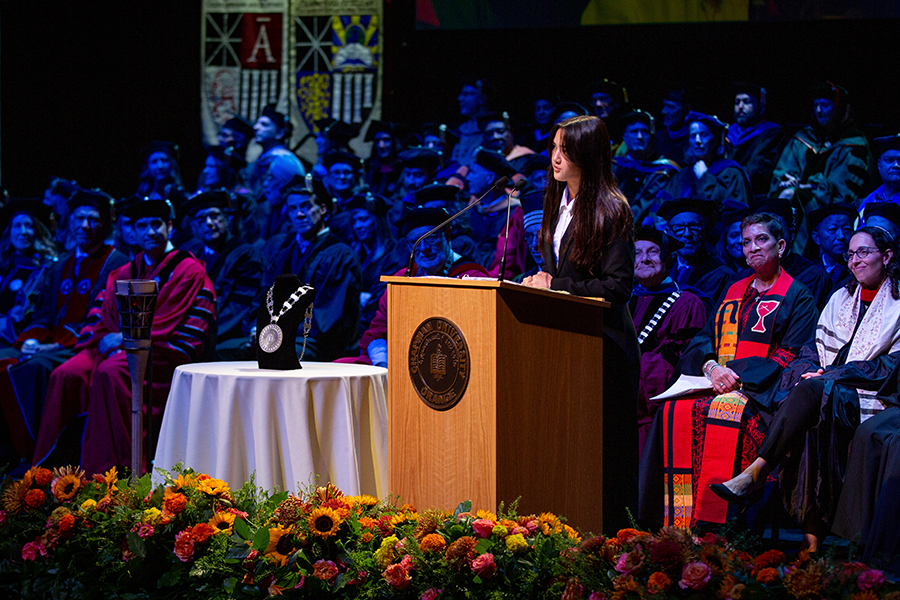
President Parlow's daughter Maya read an excerpt from Sweezy v. New Hampshire, the
1957 U.S. Supreme Court case on the importance of academic freedom to American society.
And perhaps my most important thank you is to my wife, Professor Janine Kim. Janie – I look back at the past twenty years, and I marvel at the life that we have built together. It is beyond anything I could have imagined. Thank you for your love and support and for believing in me always.
Finally, I want thank this special Chapman Family. To our faculty, you amaze me with your engaged teaching and impactful research and creative activity. To our staff, you inspire me with your talent and dedication to our students. To our alumni, you impress me with the success you are having in your careers and your service in the community. To our friends and supporters – thank you for partnering with us to advance our mission. And to our students, you are the reason we are all here. We are all invested in you and your success, and there’s a bright future ahead for Chapman because of all of you.
The Value of Higher Education
So now to the heart of my remarks. It is an interesting time to become a university
president. Higher education is under great scrutiny, and there is doubt and skepticism
in the public narrative around the value and wisdom of a college degree.
But I couldn’t be more optimistic about Chapman’s future. In fact, in my talk today,
I intend to give a full-throated defense of higher education and our mission here
at Chapman.
A college degree is inextricably linked to the American Dream. A college degree continues
to be the greatest force for social mobility in our society.
My family story reflects this. Both sets of my grandparents immigrated to the United States about 100 years ago. They came to America like so many other immigrants: to pursue opportunities unavailable to them in their home countries and to provide their children with a better life than they had. My grandparents – whom I never knew – pursued their American Dream with various jobs, from factories to farms. Yet they were not successful in their pursuits.
Both sets of my grandparents became so destitute, they had to give up my parents – my mother to a foster home, and my father to an orphanage. The American Dream had not worked out for them.
As you can imagine, this was quite a traumatic experience for my parents and grandparents. It also lit a fire in each of my parents. They each committed to getting an education in order to provide me and my brother with a better, more stable life than they had. And they did just that.
My parents scraped, and scratched, and clawed their way to earning their college degrees, becoming the first in my family to do so. They were public school teachers for 40 years, working in some of LAUSD’s most impoverished and overcrowded schools to try and help families facing the same kinds of circumstances they had.
They provided that stable upbringing for me and my brother, and they instilled in
us a reverence for education and what it can mean for a family’s future. They achieved
the American Dream.
To riff off of a famous quote from one of my legal heroes, Justice Ruth Bader Ginsburg:
“What is the difference between growing up in an orphanage or foster home and becoming
president of Chapman University?”
“One generation,” and I’d add, “an education.”
On my wife’s side of the family, my wife, her parents, and her brother all immigrated
from South Korea to America 43 years ago. Her parents left their family and the only
country they knew to come to America to give my wife and brother-in-law better opportunities
than they would have in South Korea.
How scary that must have been to move to an unfamiliar country, where they didn’t
speak the dominant language, with little money to sustain them. My in-laws worked
various manual labor jobs, saving up enough money to eventually buy a small business.
Evincing the strong work ethic that immigrants bring to our country, my in-laws worked
364 days a year, from 7 a.m. until 11 p.m. to run their small business and help put
my wife and brother-in-law through college and professional school.
My wife is now a law professor and my brother-in-law is an architecture professor.
The American Dream worked again for my family.
While the American Dream doesn’t always work for every family – my grandparents’ experience
demonstrates that – the earning of a college degree was essential in providing social
mobility for both sides of my family.
The sacrifices of my parents and my in-laws paid off. My family’s story illustrates the importance of higher education in providing the most meaningful opportunity for social mobility. Indeed, it is my family’s experience that inspired me to devote my career to higher education.
To be sure, a college education is not a guarantee, and there are others who have achieved success without it. But the indisputable truth is that there is no better way to achieve social mobility than through an education.
My wife and I have experienced that transformative effect of a college degree to lift up hardworking families and provide better opportunities for the next generation.
Not every college education is the same, and this inflection point for higher education
will challenge many institutions. But here is where Chapman’s mission, our purpose,
shines through.
What Makes Chapman Special
When the Disciples of Christ founded our predecessor entity, Hesperian College, on President Abraham Lincoln’s inauguration day in 1861, their timing was intentional. The Disciples sought to provide access and opportunity to all persons, including those who at the time were barred from pursuing an education based on their race or gender.
Our founding mission of access and opportunity continues today. Chapman University is known for its personalized education of distinction that leads to inquiring, ethical, and productive lives as global citizens. We take an individualized approach to offer our students transformative experiences and opportunities to learn, grow, and achieve.
This special educational ecosystem that we have cultivated supports our students in their path to achieving their professional dreams and life goals. Our work meaningfully advances social mobility and success.
We are committed to our four pillars -- spiritual, intellectual, physical, and social – and to the development of the whole person in our work with students.
Indeed, faculty, students, and all of us here at Chapman seek to pursue knowledge, wisdom, and understanding, to make an impact in our communities, and to make the world a better place. In our teaching and research, we explore new ideas, challenge existing paradigms, and journey on pathways to new discoveries.
Chapman helps advance society through its work and in the successful careers that our alumni have. And we see the results of this special educational environment.
Our students are providing hundreds of thousands of hours of community service through experiential learning in elementary schools to non-profit organizations to government agencies. They are conducting research alongside their professors to tackle some of the most pressing global issues and grand challenges we face. And they are winning awards and recognition across the country and around the world, from Rhodes and Fulbright scholarships to film festivals and moot court competitions.
Our faculty are among the most distinguished scholars and teachers in their fields in various nationally-ranked programs from dance to pharmacy to quantum studies. They are conducting research ranging from cancer treatment to humanomics. And they are advancing free speech and civil discourse on our campuses and in the community including educating others about the atrocities of the Holocaust and combatting the persistence of antisemitism in society.
And our alumni are leaders in business, government, and the arts – indeed, in all career paths that span our schools and colleges. They are front-line health care professionals, distinguished performing artists from Hollywood to Broadway, and teachers and administrators in our local schools. In short, they are making a real difference in their communities and raising Chapman’s profile in the process.
These are but a few examples – truly the tip of the iceberg – but they typify the impact of our faculty, students, and alumni on our campuses, in the community, and globally.
Chapman's Bright Future
It is no surprise, then, that Chapman has been on a dynamic trajectory for decades,
and as we look ahead, there are several areas of focus that will build upon our past
and propel us towards the future by continuing this exciting momentum.
The first is our students. They are the reason we are all here. Chapman has always been a student-centered institution, and we will not only remain committed to that focus, but we will deepen our dedication to student success. We will promote and support student academic, professional, and creative growth in helping them prepare for the dynamic 21st century workforce and their role in shaping society and industry.
We will also expand and increase our academic excellence. We have set an ambitious goal for ourselves to make Chapman one of the truly elite institutions in the country. We know this is a journey, but we have made great progress and so much potential exists for us to seize.
We will build upon our research profile in ways that enhance our national and international reputation. We will cultivate areas of distinction and excellence that attract students and faculty from all over the world to Chapman.
We will embrace AI, incorporating it into our teaching, research, and operations to elevate our work on our campuses and to equip our students with the skills that the marketplace will desperately need.
And we will do all of this while remaining true to our teacher-scholar model of personalized education that students past and present have enjoyed. In short, we will reach new academic heights along this journey.
Part of our growth in academic excellence will stem from a broadening of our interdisciplinary work. We have strong schools and colleges at Chapman that deliver excellent educational experiences and faculty research and creative activity. But the whole is more than the sum of the parts.
By encouraging greater cross-disciplinary collaboration, we will create meaningful synergies that will drive greater success in teaching, research, and programmatic work. We will bring together faculty and students from different disciplines to create new research opportunities and innovative degree programs that prepare our students to solve society’s complex issues and questions.
Indeed, our students will undoubtedly benefit from gaining interdisciplinary knowledge and problem-solving skills that will better prepare them for the workforce of tomorrow.
Chapman will also reach beyond its campuses to build bridges into the community, as our new partnership with the Marymount Education Foundation shows.
We are part of a robust Southern California region with great opportunities and needs. By partnering with businesses, other universities, governments, non-profit groups, and community organizations, we can create even greater opportunities for students and faculty to conduct research, enhance learning inside and outside of the classroom, build exciting internships and job pathways across industries, and provide new avenues for experiential learning that support community needs.
Finally, though certainly not exhaustively, we will deepen our commitment to free speech and civil discourse. Chapman has always been known for its commitment to free speech and to creating an environment where differing views can be heard and respected. Our political system and society more generally are failing at advancing free speech and civil discourse.
But this is truly what a university should do: expose students to views different from their own and encourage respectful conversations on difficult and complex issues. Chapman has and can continue to distinguish itself here.
Only when we have a space where all voices and viewpoints can be heard, where ideas, and theories, and solutions can be vigorously debated, where civil discourse reigns…only then can we break new ground, solve complex problems, and answer some of society’s most persistent and pressing questions.
As you can see, all that Chapman is and all that it will become speaks to the essentiality
of higher education that the United States Supreme Court effusively defended almost
70 years ago in the excerpt from Sweezy v. New Hampshire that my daughter read earlier.
A Call to Action
Together, even during these challenging times, we can further our mission, live out the promise of higher education, and provide the transformative educational experience that will advance social mobility, contribute significantly to society, open up even greater opportunities for our students and alumni, and take Chapman to new heights.
So I ask for your help today in realizing this bright future ahead for Chapman:
- Let us, together, always keep students and their success at the forefront of all that we do.
- Let us, together, continue to fan the flame of the entrepreneurial spirit that Jim Doti fused into Chapman’s DNA.
- Let us, together, continue to drive Chapman’s academic excellence forward through those conversations across space and time that Daniele Struppa embedded in our academic mission.
- Let us, together, deepen our commitment to free speech and civil discourse and be a model for other universities and society writ large in doing so.
- Let us, together, continue – continue on this exciting trajectory and enjoy the journey along the way, even when there are bumps in the road.
- And let us stand together in defense of the promise of higher education and, more importantly, for what makes Chapman special, unique, and distinctive. Only then can our students and alumni achieve their American Dream.
So I guess I end where I began. I’m humbled by this opportunity – this dream – of a lifetime to lead this special place we call Chapman. I’m honored to be part of the Chapman Family and reflect on all that we have accomplished and all that we will do together in the years to come.
And I’d like to conclude by thanking everyone again and by looking ahead toward our ambitious goals, for as our Chairman Emeritus Doy Henley likes to say, “we got work to do.”
Indeed, we do, so let’s get to it, together. Thank you very much.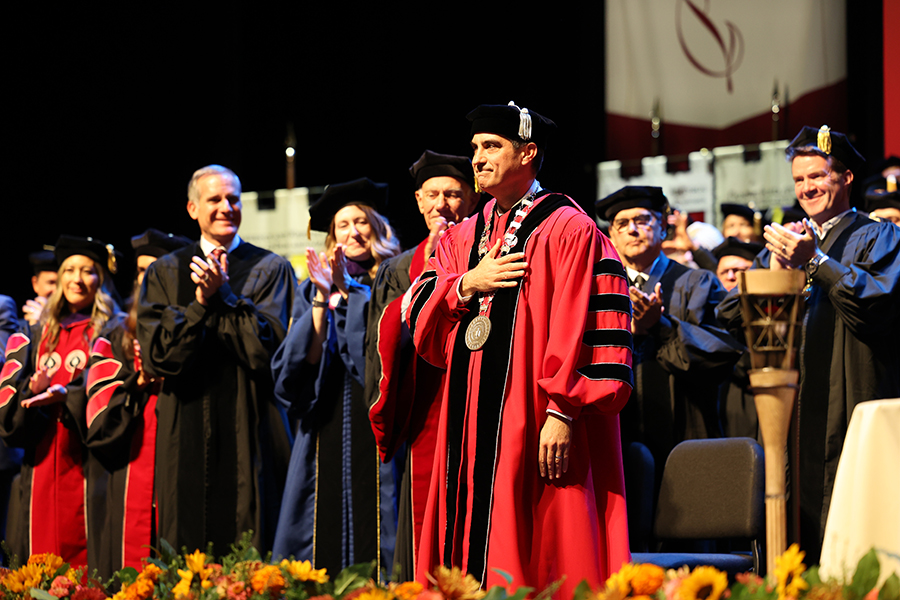
Parlow receives a standing ovation after his investiture speech.