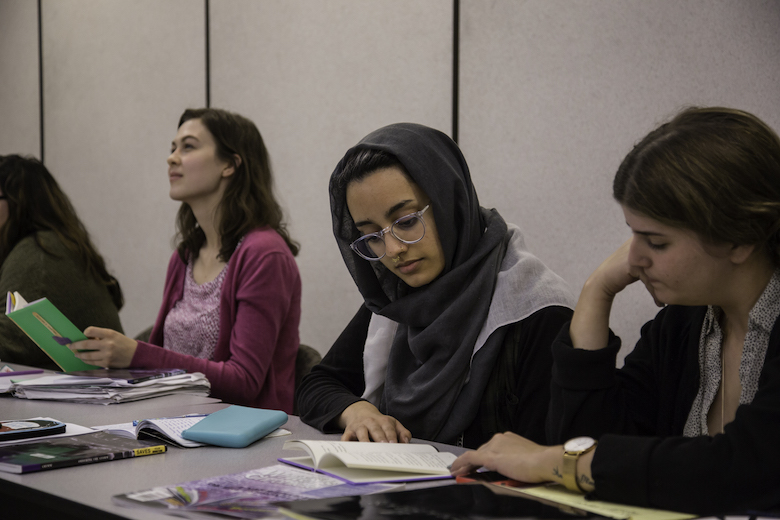
The Master of Fine Arts in Creative Writing at Chapman University’s Wilkinson College of Arts, Humanities, and Social Sciences encourages students to write boldly, read thoughtfully, and live vibrantly. Whether you’re interested in fiction, poetry, creative nonfiction, or a combination of genres, including course options in graphic novels, young adult (YA), and screenwriting, the MFA at Chapman invites you to write better than you ever thought you could.
Off
Wilkinson College of Arts, Humanities, and Social Sciences
- Graduate Studies
- MA in International Studies
- MAIS Program Handbook
- MA in English
- MA English Program Handbook
- MFA in Creative Writing
- MFA Creative Writing Program Handbook
- MA in War, Diplomacy, and Society
- MA in WDS Program Handbook
- Dual MA in English/MFA in Creative Writing
- Dual MA/MFA Creative Writing Program Handbook
- Integrated BA/MA in English
- Integrated BA/MA in War, Diplomacy, and Society
- Integrated BA/MA in International Studies
- Follow
»Master of Fine Arts in Creative Writing
At Chapman University, Your Writing Comes First
- Workshops with genre options that appeal to your tastes and style of writing including Fiction, Poetry, and Creative Nonfiction, with electives offered in areas such as Screenwriting and Graphic Literature.
- Each MFA student's degree program culminates in a book-length thesis project of distinction so that you graduate with a complete (or near to complete) manuscript, as well as a diverse portfolio from workshop writing.
- Six competitive fellowships (three awarded each year) with full tuition waiver and a fellowship payment of $18,000, each renewable for a second year and requiring no work obligation — so you can focus on writing. Limited full-tuition scholarships are also available.
- Literary events like the Tabula Poetica Reading Series every fall, the John Fowles Center Reading Series every spring, and Pub(lishing) Crawl in April make this MFA program an especially energetic milieu for emerging writers.
Alumni Spotlights

Audrey Fong, MFA '24
"The MFA program provided me with attention and one-on-one help, factors key in
making me feel like I belong at Chapman... The care and attention both helped me improve
my writing and introduced me to what the world of writing and academics looks like
beyond the classroom."
Emily Velasquez, MFA '24
"As someone who came into this program without experience in a workshop, being
among such a brilliant and exceptional group of educators and students felt intimidating.
However, I am amazed at how assignments are always geared to help you gain new practice
and skills that work towards thoughtfully and professionally shaping your ideas."

Deborah Paquin, MFA '23
"[After] a traumatic brain injury, I couldn’t sit in class without getting debilitating
migraines. Disabilities services worked with me to provide an environment where I
could succeed. As a result, I had a safe and creative place to explore new aspects
of writing and literature, along with a supportive community of teachers and students."

Tryphena Yeboah, MFA '21
"As an international student from Ghana, my experience at Chapman University and
the relationships I’ve built have been an invaluable part of my life. Not only has
this inclusive community become a home to me but it also continues to empower and
challenge me in honing my craft as a writer."
Faculty Spotlights
Professor Mildred Lewis
Courses taught: Techniques in Screenwriting, Film Theory, Caribbean Literature

Dr. Jean Ho
Courses taught: Advanced Fiction Workshop, Techniques in Fiction Writing
Dr. Anna Leahy
Courses taught: Advanced Poetry Workshop, Techniques in Poetry Writing
Toggle Section
Application Requirements
Apply now using the Online Application. All applicants must provide the following materials:
- Official transcripts from all degree-granting (bachelor’s or master’s degrees) colleges and universities attended.
- A statement of intent; an essay expressing your reasons for wanting to join the MFA in Creative Writing program. What are your personal and career goals, and how will this particular degree from Chapman University help you reach those goals? Your essay should be double spaced, size 12 font, and 1-2 pages in length.
- A portfolio of creative work. You should submit work that best represents your style and demonstrates your potential. The portfolio should include 20-30 pages of fiction or nonfiction OR 10-15 pages of poetry. While we offer courses in additional genres, please stick to fiction, nonfiction or poetry in the application writing sample. You will be prompted to identify the genre of your portfolio. This genre identification is for the submitted portfolio only, not an indication of any track in the program. While students can take courses in multiple genres, we ask that the application writing sample be in a single genre: fiction, nonfiction or poetry. Please also include your first and last name and selected genre in the document header. See here for additional guidelines.
- Two letters of recommendation that speak to academic and/or professional preparation, intellectual ability, and aptitude for graduate study.
- Your resume or curriculum vitae.
Curriculum
Students complete 36 credits of academic coursework culminating in a book-length thesis
project consisting of a novel, short story collection or poetry collection. For further
information on degree prerequisites, admission requirements and a list of courses
view the Graduate Course Catalog.
Prospective students are encouraged to explore past students' MFA theses for insight into the depth and diversity of creative work conducted in our program.
Though our creative writing students’ thesis work is embargoed for professional copyright
reasons, these projects showcase the creativity, rigor, and intellectual curiosity
that define our graduate community.
Funding Opportunities
- Six competitive fellowships (three each year) with full tuition waiver and a fellowship payment of $18,000, each renewable for a second year and requiring no work obligation. Limited full-tuition scholarships are also available.
- Paid Graduate Teaching Assistantships: For select second-year students in the competitive Graduate Student Instructor (GSI) program, teaching in our undergraduate English Composition courses. This assistantship allows first-year students who take the spring class in Teaching Composition to apply for one of the GSI positions for the following fall. The selected GSIs each teach a section of composition in the fall, while also enrolled together in a second pedagogy class. This position does not come with an award that covers tuition, but it does come with a teaching stipend — worth approximately $6,852 per course taught.
- Paid Graduate Assistantships: $36.89 an hour for 9 to 19 hours per week, for select students starting as early as their first year of study with either department faculty members or in offices across the university.
- We also have some students teaching with community organizations that are not directly related to our program. This speaks to the opportunities our students seek and create and the value of the expertise they are developing.
- Financial aid often contains mainly student loans. In addition to any program funding, you will also receive your “financial aid package” from the Graduate Financial Aid Office after you have been admitted. Regarding loans, please contact their office directly with any questions at gradfinaid@chapman.edu.
Past Visiting Writers
- Isabel Allende
- Victoria Chang
- Carolyn Forché
- Karen Joy Fowler
- Pico Iyer
- Maxine Hong Kingston
- Kim Stanley Robinson
- Rebecca Skloot
MFA Alum and Student Newsletter
Whether you are an alum or a current student, we want to help you sustain your writing life. If you have good news about a publication or a job you’ve landed or if you find an opportunity for writers that you’d like to share, please write to us at mfacwnews@chapman.edu so that we can include the info in a future newsletter. Follow us on Instagram @chapmancwmfa to stay in touch with our community.
20262025- December 2025
- November 2025
- October 2025
- Septmeber 2025
- May 2025
- April 2025
- March 2025
- February 2025
- January 2025
- December 2024
- November 2024
- October 2024
- September 2024
- Summer 2024
- May 2024
- April 2024
- March 2024
- January 2024
- Graduate Studies
- MA in International Studies
- MAIS Program Handbook
- MA in English
- MA English Program Handbook
- MFA in Creative Writing
- MFA Creative Writing Program Handbook
- MA in War, Diplomacy, and Society
- MA in WDS Program Handbook
- Dual MA in English/MFA in Creative Writing
- Dual MA/MFA Creative Writing Program Handbook
- Integrated BA/MA in English
- Integrated BA/MA in War, Diplomacy, and Society
- Integrated BA/MA in International Studies
Contact Us
Joanna Levin, Ph.D.
Program Director
Danielle Espiritu
Graduate Programs Coordinator
(714) 516-7116
Current Students: despiritu@chapman.edu
Prospective Students:
wilkinsonadmit@chapman.edu
Stella Hong
Graduate Admission Counselor
(714) 289-3590
stellah@chapman.edu
For additional admission information, please contact:
Office of Graduate Admission
888-CU-APPLY or (714) 997-6711
gradadmit@chapman.edu
Application Deadlines
Apply now using the Online Application. Submit your application and all supporting documents by the deadline listed below.
Applications received after these deadlines will be considered on a rolling basis as space is available.
- Fall Semester & Priority Fellowship Consideration: February 1
- Spring Semester: November 1