»Le lacrime di Firenze
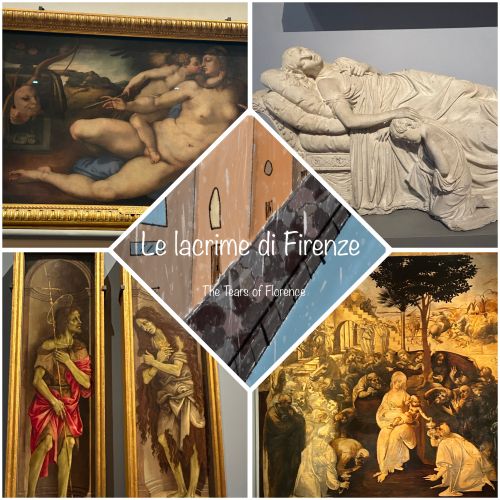 Le lacrime di Firenze is a musical composition, diving into various depictions of grief, death, and other
psychological phenomena. It grapples with questions of how the Italian Renaissance,
with the exclusion of one Romantic sculpture, depicted death and grief. The music is
set in the Florentine Renaissance. After listening to various musical compositions
by various Renaissance composers, seeing art in various museums with my class, attending
mass, and attending Italian concerts, I was able to compose my work. My work of music
is centered around the city of Firenze and four artworks: the Tryptich of Saints Mary
Magdalene and St. John the Baptist, The Adoration of the Magi, Cupid and Venus, and
a Romantic funerary statue. Much of the sounds heard in the music come directly from
my experience in Italy. I chose to incorporate chimes, which are church bells signaling
the start of the new day. I included the sounds of car horns in the alto saxophone,
warning pedestrians and tourists that there is a car behind them. The listener can
hear the ambulance sirens played by trumpets, wailing in the background as you begin
to travel to Renaissance Italy. There are aspects of modern Firenze with a Renaissance dance
feel. I tried very hard to listen to music that would allow me to write in such a
style. It follows Renaissance musical form, such as Fast, Slow, Fast, and so on. I
was inspired by the Renaissance/ Baroque form known as the Ritornello form, which
has alternating bits of music between the same and different types. The music itself
is modal because during the time period, Renaissance music was not tonal. I included
the “Devil’s Mode,” the Locrian scale, because it is tense and dissonant. While it
was frowned upon in the Renaissance (suggesting a modern perspective), it portrays
the tension that many of these artworks had, and death. I also included the motive
from the Gregorian chant “Dies Irae” in elongated rhythms to solidify the idea of death
and grief. Each musical section depicts a different key element in each of the paintings, which
you can read in the program notes. Enjoy the Music!
Le lacrime di Firenze is a musical composition, diving into various depictions of grief, death, and other
psychological phenomena. It grapples with questions of how the Italian Renaissance,
with the exclusion of one Romantic sculpture, depicted death and grief. The music is
set in the Florentine Renaissance. After listening to various musical compositions
by various Renaissance composers, seeing art in various museums with my class, attending
mass, and attending Italian concerts, I was able to compose my work. My work of music
is centered around the city of Firenze and four artworks: the Tryptich of Saints Mary
Magdalene and St. John the Baptist, The Adoration of the Magi, Cupid and Venus, and
a Romantic funerary statue. Much of the sounds heard in the music come directly from
my experience in Italy. I chose to incorporate chimes, which are church bells signaling
the start of the new day. I included the sounds of car horns in the alto saxophone,
warning pedestrians and tourists that there is a car behind them. The listener can
hear the ambulance sirens played by trumpets, wailing in the background as you begin
to travel to Renaissance Italy. There are aspects of modern Firenze with a Renaissance dance
feel. I tried very hard to listen to music that would allow me to write in such a
style. It follows Renaissance musical form, such as Fast, Slow, Fast, and so on. I
was inspired by the Renaissance/ Baroque form known as the Ritornello form, which
has alternating bits of music between the same and different types. The music itself
is modal because during the time period, Renaissance music was not tonal. I included
the “Devil’s Mode,” the Locrian scale, because it is tense and dissonant. While it
was frowned upon in the Renaissance (suggesting a modern perspective), it portrays
the tension that many of these artworks had, and death. I also included the motive
from the Gregorian chant “Dies Irae” in elongated rhythms to solidify the idea of death
and grief. Each musical section depicts a different key element in each of the paintings, which
you can read in the program notes. Enjoy the Music!
Listen to the music
Read the score
Student: Ana Rubio (Performance BM and Psychology BA, Minor in Honors Program, 2026)
Mentors: Dr. Federico Pacchioni (Italian Studies) and Dr. Louise Thomas (Music)