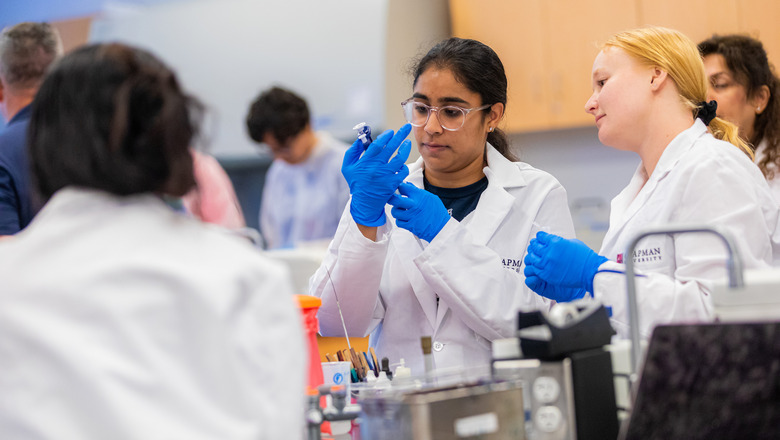
• Students working in a classroom
Pre-Health Professions Office

Frequently Asked Questions

»Frequently Asked Questions

Below are answers to common questions about preparing for a medical career while an undergraduate student. 

If you can’t find the answer to your question below, feel free to email us at prehealth@chapman.edu

Coursework questions


Toggle Section

While there may be differences by program and specific schools, courses typically include biology (with labs), chemistry (with labs), organic chemistry (with labs), physics, calculus, statistics, and English composition. 

You may also be required to take courses such as Microbiology, Anatomy, Physiology, Medical Spanish, and Medical Ethics, depending on the program.

For more specific details, visit our Course Requirements section.

The easiest answer is it depends. 

While Chapman accepts AP credit for many courses, we do not recommend using that AP credit for your science prerequisites, particularly biology or chemistry.

You can take some courses during the summer; however, be judicious about choosing which courses. 

Also, make sure to check with Chapman’s Academic Advising before you make this decision to ensure you can meet all transfer requirements. 

It really depends. 

There may be some instances where online courses are accepted, but in general, it is not recommended that you take any science prerequisite courses online. You run the risk of that course being rejected during the application cycle.

In general, yes. However, as with other questions, be judicious. 

Admissions committees still want to see that you can be successful in a rigorous science curriculum. And, if you are taking these courses while enrolled at Chapman, check to make sure what you are taking meets Chapman’s requirements and transferability. 

Clinical experience questions


Toggle Section
While this is program and school-specific, most want you to have clinical experiences, community service, research, and various extracurricular activities that demonstrate your leadership, ability to work with teams, and time management.
Health professions schools expect prospective applicants to have developed a rich set of experiences that have informed their understanding of health care, challenged their intellect, demonstrated their commitment to others, and finally, demonstrated their motivation for the profession.

There are many ways to gain clinical experience, including:

  • Shadowing: Shadowing is usually the first of many experiences for many premedical students. This experience is a great way to determine if medicine is potentially the path for you. You should learn the “day in the life” and begin to help you draft some experiences within your application. It also gives you an opportunity to learn about different specialties.
    • The time you shadow is determined by your availability and the doctor’s availability. It may be for a few hours in a day/week and it may be more long term, weeks or months. Work with the physician to see what they have done in the past.
    • Dress professionally but comfortably. You will probably be on your feet for the day. Bring a notebook and be prepared to ask questions between patients. You may also prepare some questions in advance of the session.
    • The physician will introduce you to the patients and explain that you are a premedical student, so you should expect to speak with patients. Whether or not you stay in the room will depend on the patients’ levels of comfort; don’t be surprised if you’re asked to leave the room. No matter whether or not you are in the patients’ rooms, all information you hear, read, and discuss is confidential.
    • Learn more about shadowing a doctor here.
  • Volunteering in hospitals/clinics: Contact your local hospital(s) to see if they have volunteer programs. This will allow you to see some of the inner workings of a hospital and work with other allied health professionals.
    • How do these other professionals interact with the physician? How do these other professionals interact with the patients? Think about what you can learn from this type of experience.   
  • Student-Run Clinics and Community Clinics: Many schools, particularly medical schools, offer student-run clinics that allow for 1-2 pre-med volunteers. Check to see what is available at your institution. 
    • In addition, many urban areas, particularly those in low-income communities, have community clinics that may be looking for volunteers. 
    • If you speak another language, particularly one that is prevalent in the area of the community clinic, you may consider becoming a translator.
  • Hospital/Physician’s Scribe: A scribe is usually a paid position found in the Emergency Department and assists the on-call physician with gathering information and making documentation.
    • This is a unique opportunity to partner with a provider in care delivery. You are learning more about the physician/patient interaction and may have opportunities to take initial histories, time to discuss the physician’s clinical reasoning with certain patients, and opportunities to shadow.
  • Emergency Medical Technician (EMT): Serving as an EMT is a great way to gain hands-on experience as an entry-level healthcare provider. This opportunity could come as a volunteer opportunity (at school games, events, etc.) or as a paid opportunity on weekends.
    • EMTs provide a much-needed service in their communities and are exposed to various medical conditions. You will hopefully become knowledgeable about the healthcare needs of a variety of patients and various environments. 
  • Certified Nursing Assistant (CNA): Becoming a CNA is a great way to earn additional income and get hands-on practice while spending time in a clinical environment. 
    • CNA training programs vary in length, from four to sixteen weeks, and are offered by local community colleges, vocational schools, and the Red Cross. 
    • One benefit of working as a CNA is the flexible hours, so you may be able to work an evening or weekend shift that does not conflict with your classes or other activities.
  • Hospice Volunteer: Either in addition to or instead of, you may also find opportunities to volunteer in hospice care. The AAMC cites that medical students dealing with the death of a patient is a stressful time during their training. 
    • If you have the opportunity to spend time as a hospice volunteer, it may help you better understand the emotional toll of caring for a dying patient and see first-hand how care providers interact with patients and their families at a time when they are most vulnerable. 
    • In addition, there are counselors on staff who may help you process your feelings and experiences.
  • International Medical Service Events: Check with your university to see if they have global volunteer opportunities to allow you to offer medical service to international communities.


  • Other possible options:
    • Military corpsman/Combat medic
    • Registered Nurse
    • EEG or EKG technician
    • Emergency Room Technician
    • Physical Therapy Aide
    • Medical Assistant
    • Respiratory Therapist
    • Dietician
    • Phlebotomist
    • Medical Technologist
    • Dental Hygienist or Technologist

Instead of focusing on the number of hours, focus more on the learning. In general, you want a set of experiences that demonstrate to an admissions committee that you are committed to the profession. But, to help quantify, start and don’t stop. This could be 2-4 hours per week, or it could be a job. 

The exception to this is the number of hours needed for PA school. They do have a minimum requirement of 1,000 hours of hands-on clinical experience with patients. Beyond the minimum, they are accepting and matriculating students who have closer to 2,500 hours.

When you think about community service, you should be focused on a commitment to “something larger than yourself.” You want to commit to making meaningful contributions to a community and do what you’re passionate about. 

Service or non-profit organizations

  • Teach for America
  • City Year
  • Americorps
  • Habitat for Humanity
  • Crisis Text Line
  • Unhoused shelters
  • Missions
  • Community Centers
  • Food Banks
  • Immigration Services
  • Children’s Programs
  • Women’s Programs
  • Church, synagogue, mosque

As with most answers, it is program-specific. It is beneficial since it shows students the intricate connection between research and patient care, it enhances their ability to read dense scientific texts/articles and puts them in a professional environment. 

Students at Chapman have many opportunities to gain research on campus. Your first point of contact should be any of your professors. You can ask them if they are accepting undergraduate students in their lab. 

Another excellent Chapman research opportunity is through the Center for Undergraduate Excellence.

Medical school-specific questions


Toggle Section

No, medical schools accept students from a wide range of majors. The most important thing is your competence in the sciences and completion of required coursework. 

Pick the major you are most passionate about and work with your advisors to make sure you have all the prerequisites you need to be ready.

First and foremost, always know the averages of the students who are matriculating to medical school. Currently, it is around 3.6-3.7 for both science and overall GPA. 

However, you really want to demonstrate your academic abilities. Generally, the preferred GPA to apply is 3.4+ (without post-baccalaureate or special master’s degree enhancement). 

If your GPA is at or below 3.4, schedule an appointment to discuss your overall situation and plans. Remember, GPA is one of many metrics within your application.

Since most medical schools have an expiration, it is advised that you test within close proximity of your application. This means that it is advised you test within the year you apply. 

If you plan to apply with no gap year (at the end of your junior year), you should consider the summer between your junior and senior years or in January - April of your spring semester before the application is submitted.

Please remember that it takes a month for the score to post and you want to have your score before applying. If you plan to retest, we encourage you to schedule an advising appointment.

When you start at Chapman, you should think like a Pre-Health student. Please see the 4-Year Plans page for how to navigate your 4 years and incorporate the various extracurricular activities needed to be competitive. 

You should also work with the Pre-Health Advising Office to ensure your overall readiness. Think about what you’ve done, what gaps you may have, your academics, and the overall timing and your goals. Based on that, we will work together to determine your timeline.

  • Since the application opens in May, you should begin thinking about the exams and readiness at least 1-2 years prior. 
  • You should schedule your Application Profile meeting each semester 2 years before to ensure your readiness aligns with your goals. 
  • You should plan to submit within the first two weeks of June for the earliest turnaround for verification. There is still room to submit later, but not too much. Check with the advising office about your exact timing. 
  • You should anticipate applying to at least 20 schools and depending on your goals and profile, your financial resources, and geographic preferences, you may apply to closer to 30 schools. You may also apply to a mix of MD and DO schools. 

Dental school-specific questions


Toggle Section

You should plan to take the test within the year you are applying to dental school. 

The application opens in late May, and you need a two-week buffer for the score to post, so you should test no later than late April/early May to ensure you have a score before you apply.

Depending on your goals, profile, financial resources, and geographic preferences, along with finding the schools that are “right” for you, the numbers vary. 

The average number of schools ranges from 8-15.

Physician assistant-specific questions


Toggle Section

Many PA programs require a significant number of direct patient care experience hours as a minimum. The average number of PCE hours accrued by students being accepted to PA school is greater than 2,000

In order to meet this requirement, the average number of gap years taken by PA students is two, meaning they work for a full year after graduating and then apply while still working full-time with patients.

You should plan to take the GRE within the year you apply to PA school. 

Depending on your goals, profile, financial resources, and geographic preferences, along with finding the schools that are “right” for you, the numbers vary. The average number of schools ranges from 8-15.

Contact your Pre-Health Advisor


Chapman's dedicated Pre-Health Advisor is Randy Zuniga. Randy is available to all Chapman students and alumni interested in learning more about medical and professional school. 

Email: 
prehealth@chapman.edu

Current student appointments

Alumni appointments