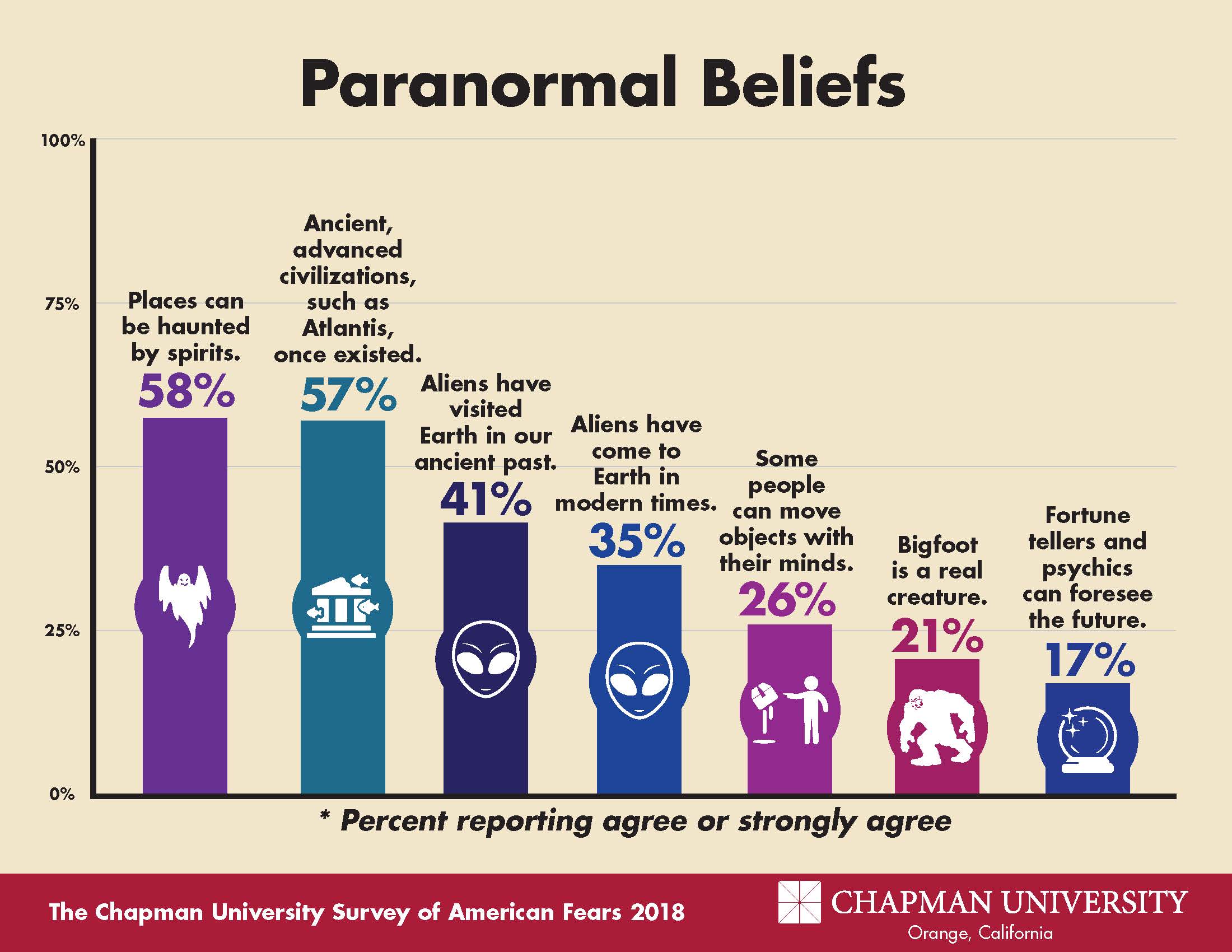
What are Americans really afraid of?

The Chapman University Survey on American Fears

»The Division on the Study of American Fears

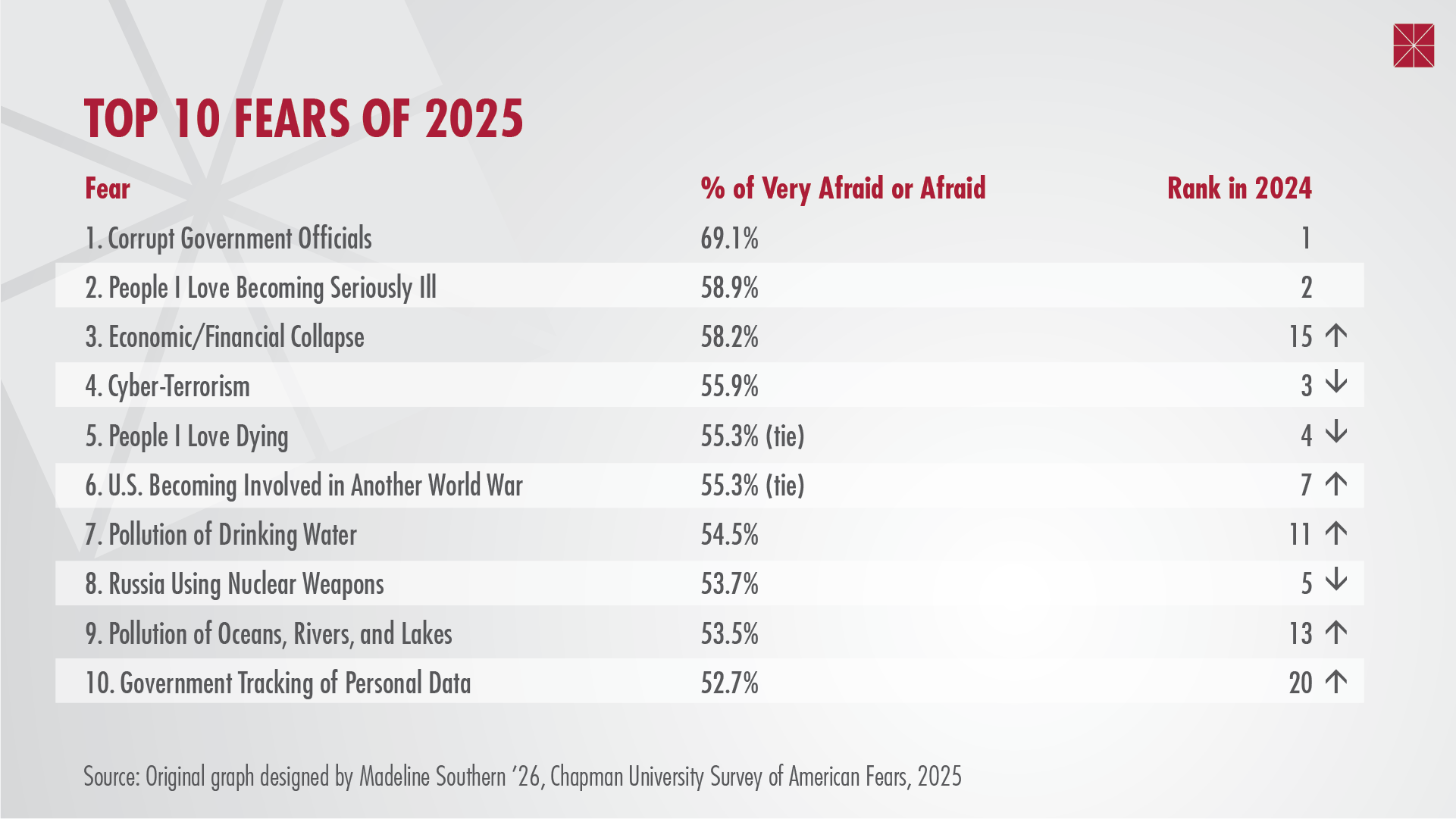
American’s Top Fears 2025

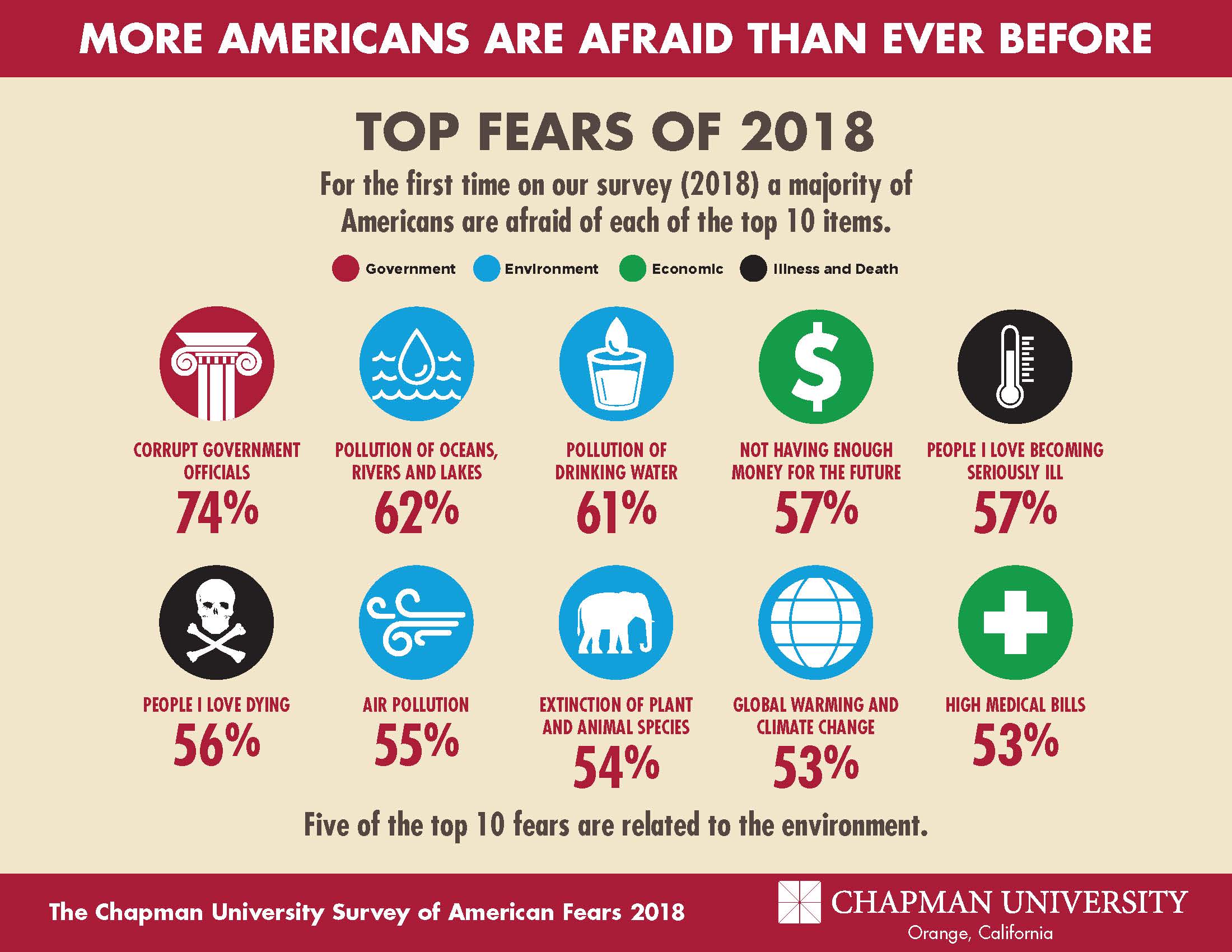
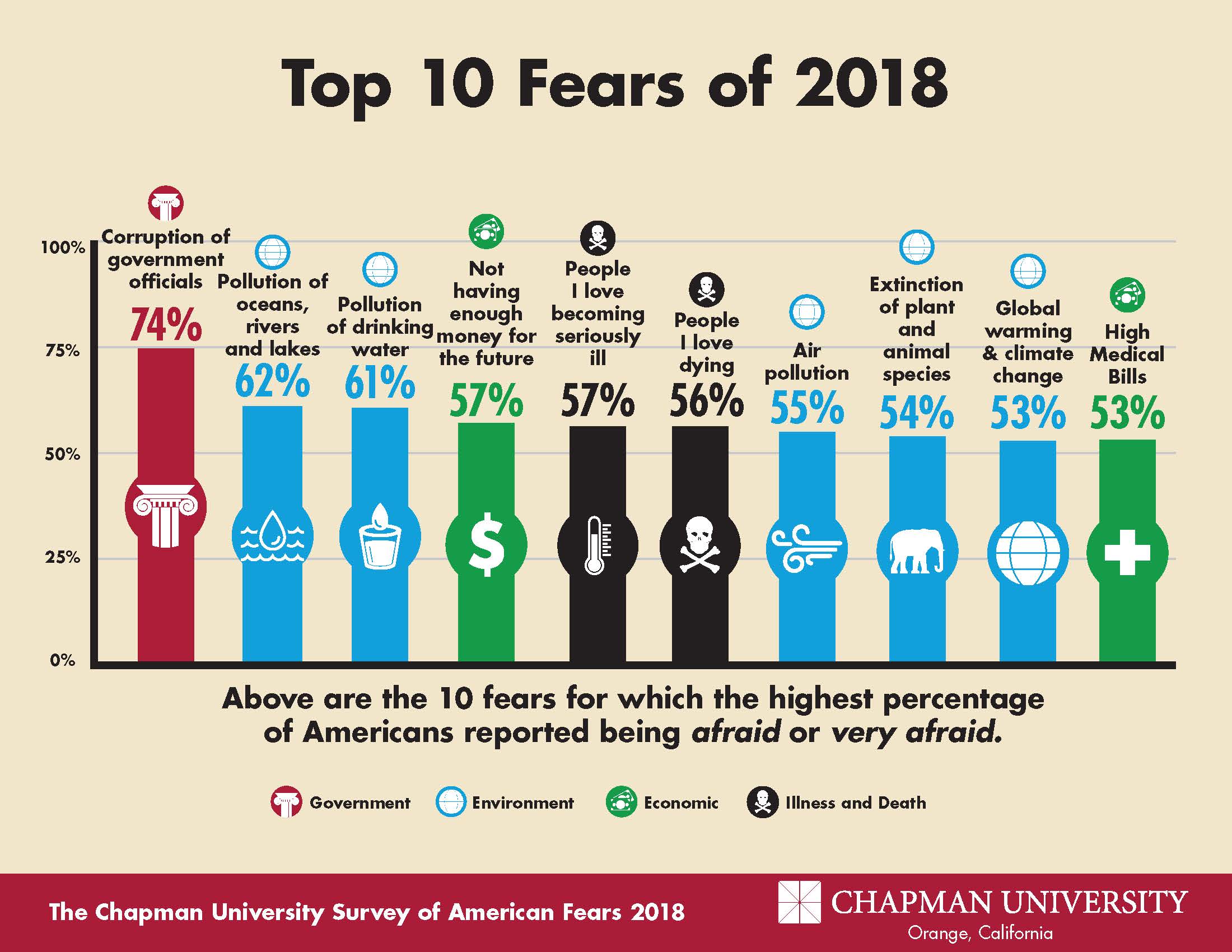
What are Americans really afraid of? Find out the Top 10 fears for 2025, taken from the Chapman University Survey of American Fears. Fears are ranked by the percent of Americans who reported being afraid or very afraid.

In keeping with the Babbie Center’s mission to address critical social issues through cutting edge social science research, we have engaged in an unprecedented, on-going study of fear in America. Now in its 10th year, the Chapman Survey of American Fears (CSAF) asks a representative national sample of Americans about more than 90 fears and related behaviors. The FEAR survey has been cited in over 1,000 print, broadcast and online media, including the New York Times, The Huffington Post, CBS This Morning, Yahoo News, NPR, Good Housekeeping, the Washington Post, USA Today, Rolling Stone, and TIME.

Student researchers are a central part of the FEAR project. They are involved in every aspect of the survey, from researching new content areas, to writing questions and analyzing results. In addition, more than 100 undergraduate research projects have used the CSAF, these are archived in Chapman University’s Digital Commons.

Fears Survey 2025 Supporting Documents

document

Chapman Survey of American Fears 2025

View Doucument

document

Survey of American Fears Methodology

View Doucument

document

Top 10 Fears of 2025

View Document

test

The Complete List of Fears for 2025

View Document

test

Alphabetical List of Fears 2025

View Doucument

test

American Fears Compared - Wave 10 and Wave 11

View Document

Frequently Asked Questions


Toggle Section

What is the purpose of this survey?

The goal of the Chapman University Survey of American Fears is to collect annual data on the fears, worries and concerns of Americans, the personal, behavioral and attitudinal characteristics related to those fears, and how those fears are associated with other attitudes and behaviors.

How often is the survey collected?

The Chapman University Survey of American Fears has been conducted annually since 2014. Data collection is usually conducted in the spring with related press releases occurring the following fall. For exact dates of data collection of each wave, please refer to the methodology reports.

Due to the Covid pandemic, no survey was conducted in 2020. Wave 7 was conducted slightly early, in January of 2021, in an attempt to partially fill the gap. Wave 8 returned to the spring administration schedule.

What is the institutional home of this project?

The Chapman University Survey of American Fears is conducted annually by the University’s Wilkinson College of Arts, Humanities, and Social Sciences, a collaboration between the Ludie and David C. Henley Social Sciences Laboratory and the Earl Babbie Research Center.

Who should I contact if I would like to conduct an interview related to this project?

Please contact the Chapman Public Relations Office at:

pr@chapman.edu
(714) 744-7677

What is the correct citation for the survey?

Sample citation:

Bader, C. D., Day, L. E., & Gordon, A. (2024, September 20). Chapman University Survey of American Fears, Wave 8 (2022).

Who collected the data?

The Chapman University Survey of American Fears (CUSAF) contracts with independent research firms to ensure that the sample is representative of the United States population. For Waves 1 through 3, this work was conducted by GfK Group. Since Wave 4, the survey has been conducted by SSRS, an internationally recognized leader in the collection of data using online-based probability panels. The sample used for the Chapman University Survey of American Fears mirrors the demographic characteristics of the U.S. Census. For additional methodological details, see the full methodological reports.

How large is the sample and is there a margin of error?

The size of the sample and margin of error will vary by year and researchers should refer to the methodology report. As a general rule, the sample size varies between 1000 and 1200. The margin of error for the entire sample will vary between 3.5 and 4.0%.

Where can I find complete results for the Chapman University Survey of American Fears?

Please see the links above for reports from Chapman.

The complete data sets are archived and released to the public on a rolling basis at The Association of Religion Data Archives (the ARDA) at:  
https://thearda.com/data-archive/browse-category?cid=C-A-A-N

Meet the Research Team

photo of Dr. Christopher Bader

Dr. Christopher Bader

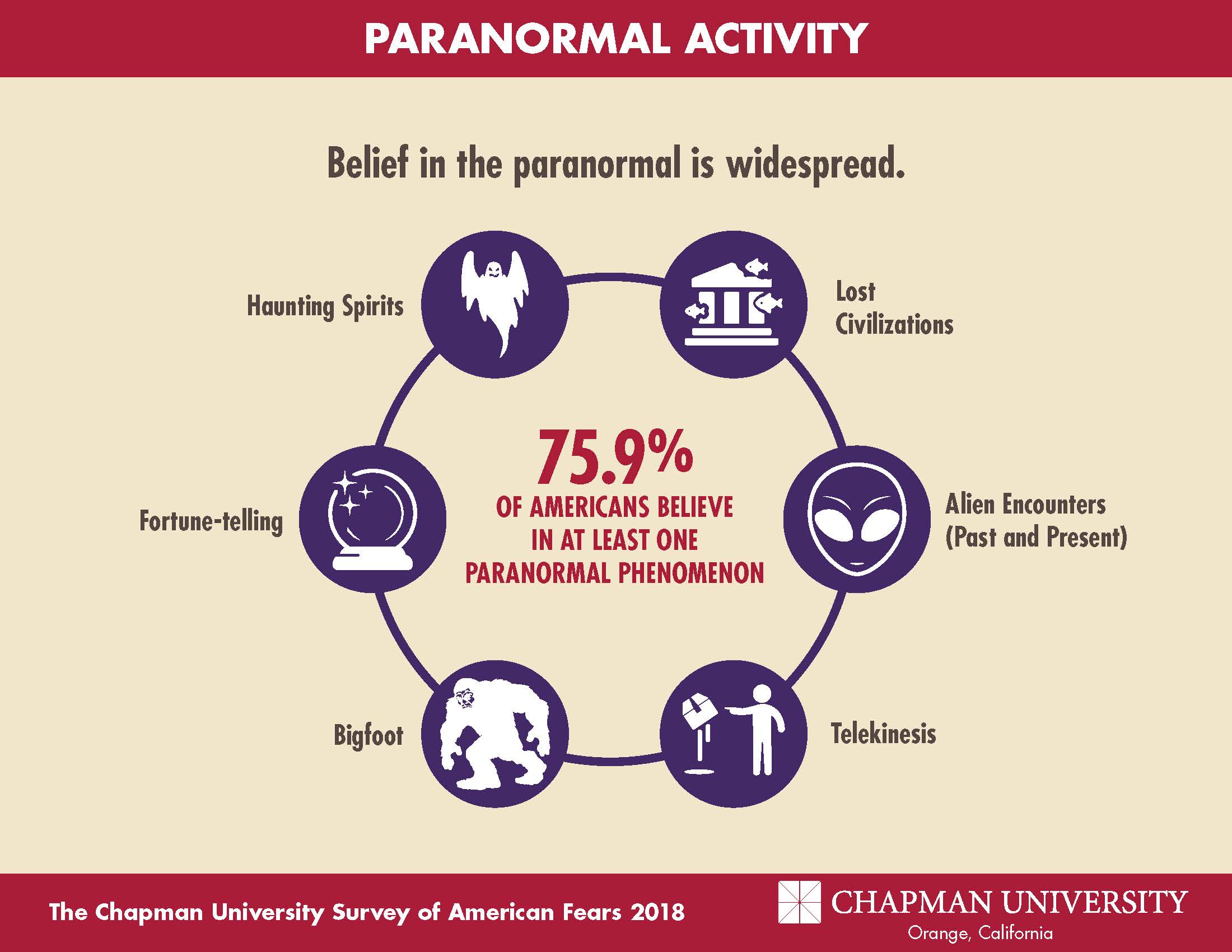
Top 10 Fears, Conspiracy Theories, the Paranormal
photo of Dr. Edward Day

Dr. Edward Day

Top 10 Fears, Fear-based Actions
photo of Dr. Ann Gordon

Dr. Ann Gordon

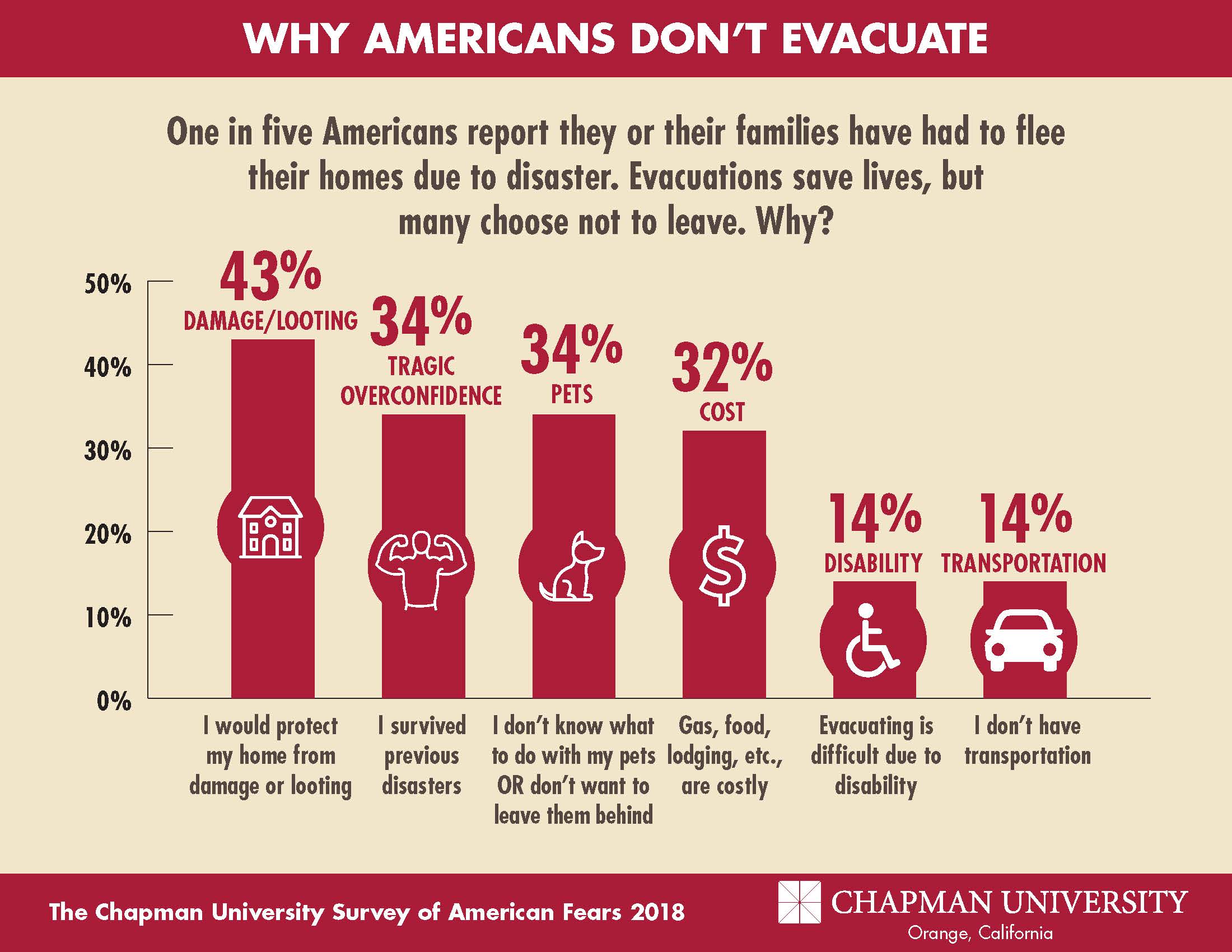
Responses to Disasters
photo of Dr. David Shafie

Dr. David Shafie

Environmental Fears and Climate Change
photo of Dr. John Compton

Dr. John Compton

Election Fears, Religion and Politics
photo of Dr. Steven Pfaff

Dr. Steven Pfaff

Fear of Political Corruption
photo of Dr. Karen Snedker

Dr. Karen Snedker

Additional Resources


Toggle Section

WATCH! Fear: Buried Alive: American Fear Special on A&E

embed here

Books Written by Our Researchers

Fear Itself
The Causes and Consequences of Fear in America

By Christopher D. Bader, Joseph O. Baker, L.Edward Day and Ann Gordon 
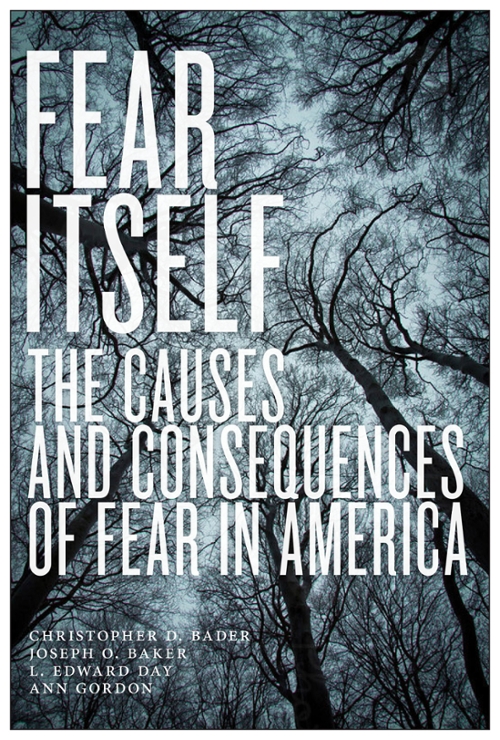
Fear Itself Book CoverForeward by Earl Babbie
Published by: NYU Press

An antidote to the culture of fear that dominates modern life

From moral panics about immigration and gun control to anxiety about terrorism and natural disasters, Americans live in a culture of fear. While fear is typically discussed in emotional or poetic terms—as the opposite of courage, or as an obstacle to be overcome—it nevertheless has very real consequences in everyday life. Persistent fear negatively affects individuals’ decision-making abilities and causes anxiety, depression, and poor physical health. Further, fear harms communities and society by corroding social trust and civic engagement. Yet politicians often effectively leverage fears to garner votes and companies routinely market unnecessary products that promise protection from imagined or exaggerated harms.

Drawing on five years of data from the Chapman Survey of American Fears—which canvasses a random, national sample of adults about a broad range of fears—"Fear Itself" offers new insights into what people are afraid of and how fear affects their lives. The authors also draw on participant observation with Doomsday preppers and conspiracy theorists to provide fascinating narratives about subcultures of fear.

"Fear Itself" is a novel, wide-ranging study of the social consequences of fear, ultimately suggesting that there is good reason to be afraid of fear itself.

Praise for Fear Itself:

"Those of us who study fear have long been grateful for the Chapman University Survey of American Fears. In this important book, the scholars behind that survey examine their data and provide invaluable insights into what Americans fear and the effects of those fears."

Barry Glassner, author of The Culture of Fear: Why Americans Are Afraid of the Wrong Things

"A careful, well-reasoned, and convincing study of fear in contemporary American society."
Steve Pfaff, University of Washington
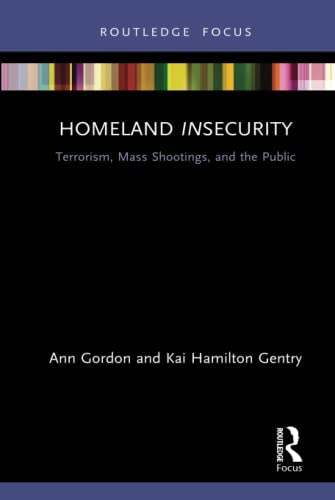

Homeland InsecurityHomeland Insecurity

By Ann Gordon and Kai Hamilton Gentry ('17 Political Science)

In this book, Ann Gordon and Kai Hamilton Gentry (Political Science, Class of 2017) expertly illuminate how the public has a role to play in ensuring its own security.

Learn more about this research here.