
ESI > What is... Economic Science Institute


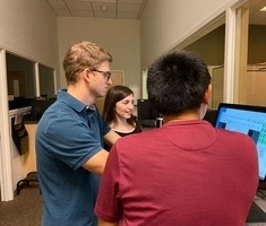
Students participate in a double auction experimentAbout Experimental Economics

New to Experimental Economics? Let us answer a few questions...


What Is ESI?

The Economic Science Institute at Chapman University is a center that uses the laboratory method of inquiry to expand our understanding of human socioeconomic behavior.  The research mission of ESI is to study the function and origin of human institutions in creating social rules and order and to build and test market and management systems.  The research at ESI spans the fields of accounting, economics, finance, information systems, engineering, psychology, neuroscience, computer science, and philosophy.

What Is Experimental Economics?

Prior to the development of experimental economics, economists focused on theories relying heavily on mathematical abstractions about how people behave and how markets work. The fact that markets in natural environments are dynamic and operate in specialized institutional settings led Prof. Smith in 1956 to look to the laboratory to determine whether these abstractions were, in fact, descriptive of market behavior and thus testable in a scientific way.  Using cash-motivated students, ESI experiments create real-world incentives to help us better understand why markets and other exchange systems work the way they do.  

Students participate in a double auction experimentWhy Use Experimental Economics in the Classroom?

For many students, economic principles are rather abstract and unintuitive, particularly how a market functions. In our courses students participate in markets and other exchange settings before discussing the theory behind the experiment.  Afterwards in the course of the lecture, students observe how well their own behavior, without any knowledge of the theory, conforms to the economic principles under discussion. Sometimes traditional economic tools do an excellent job organizing their behavior and sometimes not. In both cases, the question we explore with the students’ own data is, “Why?”.  When a theory fails to predict, it is usually because people do better than what the economic model predicts.


Do You Want to Read More About Experimental Economics?

See the following resources:

 
©2009 Chapman University • One University Drive, Orange, CA 92866 • Phone: (714) 997-6815
Website Powered by ActiveCampus™ Software