|
|
Financial Times, London "How the west was sung" By George Loomis
Published: February 15 2008 02:00
Who was the catalyst for a distinctive American musical style? The answer
came near the end of the Pacific Symphony's eighth American Composers
Festival: Antonín Dvorák, who, of course, was no American. In his three
years in America, the Bohemian composer not only criticised native
composers for imitating Europeans but also showed them how to write
concert music imbued with indigenous American elements.
Dvorák was not a primary focus of this year's festival, having supplied
grist for a previous one. But he was the starting point for an exploration
of music inspired by the American frontier. The haunting Largo from the
New World Symphony took on new meaning in a visual presentation involving
projections of vast outdoor canvases by the likes of Albert Bierstadt and
Frederick Remington. This music was a launch pad for the "simple textures,
widely spaced chords and non-directional harmonies" that, as the
festival's artistic adviser Joseph Horowitz informed audiences, are common
elements of music evocative of the frontier. Works by, among others,
Virgil Thomson, Aaron Copland, Roy Harris and Lou Harrison bore him out,
and two composers-in-residence, Stephen Scott and Curt Cacioppo, supplied
newer music in similar vein.
The Pacific Symphony's annual exploration of America's musical heritage is
probably unique and certainly thought-provoking. It brings critical
attention to America's youngest major orchestra (founded in 1978), one
that continues to forge its identity in the shadow of the Los Angeles
Philharmonic. Until an acclaimed German tour in 2006, the orchestra had
hardly left Orange County. But that same year it moved into the gleaming
new César Pelli-designed Renée and Henry Segerstrom Concert Hall in Costa
Mesa, one of the last halls masterminded by the late acoustician Russell
Johnson.
The orchestra's success in Germany was no coincidence, for its music
director, Texas native Carl St Clair, is possibly better known there than
at home. Currently general music director of Weimar's German National
Theatre and Staatskapelle (he leads the Ring in July), St Clair takes over
Berlin's Komische Oper this year.
From a taxing and varied festival programme, the late Lou Harrison's Four
Strict Songs , a product of his early emancipation from serialism (1955),
emerged as a high point. Choral statements (by the Pacific Chorale) of the
composer's Navajo-inspired texts, set to enthralling pentatonic melodies,
had an awesome grandeur, while archaic just intonation and a percussion
battery augmented by water bowls and maracas brought arresting qualities
to the orchestral support.
Scott can safely be numbered among composers who have devised means of
sonic expression that are truly their own. He and the nine other
performers of his Bowed Piano Ensemble probe the insides of a piano with
implements such as nylon fish line, horse hair on tongue-depressors and
guitar picks; in the process they obtain an unexpected array of euphonious
results.
Scott's roots as a Steve Reich-inspired Minimalist ensure that his
compositions are far from being simple aggregations of random sounds.
Tonality is indeed a possibility, one exploited in "Sun Catcher" from
Vikings of the Sunrise , in which industrial-sounding pulsation supports
intertwining, long-breathed melodic lines. In Pacific Crossroads , heard
in its world premiere, the mini-orchestra generated by the piano
interacted with the real one for a whimsical evocation of western figures
ranging from the explorer Balboa to the sculptor Richard Serra. For those
concerned about the well-being of the participating Steinway, it took
about 30 minutes to restore it to its original pristine condition.
Cacioppo's Crying for Justice (1998), given its professional premiere,
touched on the mistreatment of native Americans. Peaceful flute musings
are encroached upon by an insistent tune and by powerful unisons en route
to a strong but inconclusive close suggesting that the story is not over.
Listening material of a more accessible sort was supplied by two movements
from Ferde Grofé's Grand Canyon Suite (1931) - not the hackneyed
donkey-clomping of "On the Trail", but "Sunrise" and "Cloudburst", in
which the piece behaves almost as if it were an American Alpine Symphony .
St Clair was alert to opportunities for bringing his orchestra's capacity
for colour and virtuosity to the fore, and it responded handsomely. He and
the orchestra also gave a robustly picturesque account of Copland's Suite
from Billy the Kid .
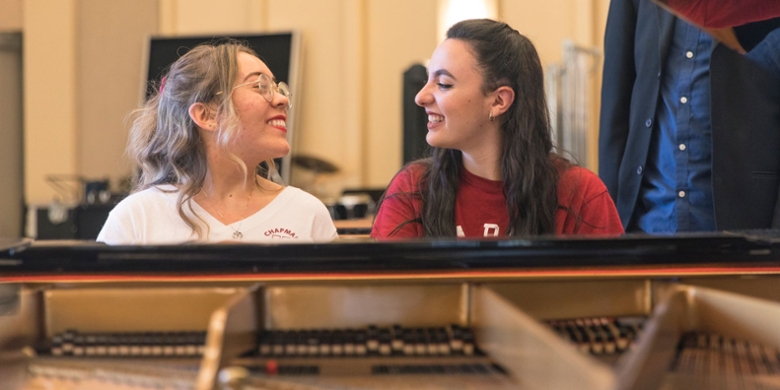
A concert on the campus of Chapman University, in addition to proclaiming
Dvorák's seminal importance by way of pianist Grace Fong's fluent
performance of excerpts from his American Suite , uncovered fascinating
works from the early 20th century by Arthur Farwell, who lived for a time
in a native American village on Lake Superior and soaked up its musical
culture. Artistic adviser Horowitz's designation of Farwell as "an
American Bartók" seemed apt given Fong's performance of Navajo War Dance
No 2 , an arresting piece with percussive themes of irregular phrase
lengths. She also played his brief Pawnee Horses , which proved even more
striking in its a cappella choral version (sung by the Chapman University
Choir); with its hocket-like writing, it seemed to dart between modernism
and something from the Middle Ages. Cacioppo's Tuscon Scherzo , a
well-constructed work of contrapuntal ingenuity for piano, flute,
clarinet, violin and cello, testified to the continuing appeal of
"Indianism".
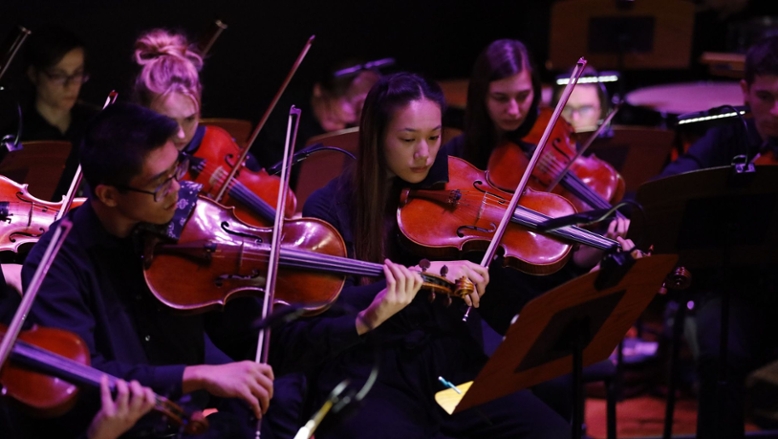
The concert ended with a screening of the 1936 New Deal documentary The
Plow that Broke the Plains , supported by a performance of Thomson's
enduring score by members of the Pacific Symphony and the Chapman Chamber
Orchestra, expertly synchronised by the conductor Daniel Alfred Wachs. In
spite of the film's subject of hardship in America's dustbowl, the hymn
tunes, cowboy songs and dances of Thomson's irrepressible music expressed
American resilience and optimism. The latter was surely a subtext of the
documentary. And it was underscored by the American Composers Festival
itself.
Copyright The Financial Times Limited 2008
|